Wednesday, June 20, 2012

Play by Post: First Impressions

Role-playing
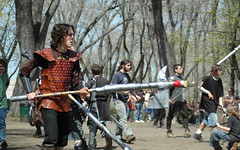
Play by post gaming is sort of the opposite of this, thank goodness. (Photo credit: mricon)
I first heard about play by post games via the Exemplary DM Podcast.  On the surface, it sounded neat: play within the bounds of your time.  But the description that the guests on that show provided ultimately turned me off: focus on literary style, emphasis on roleplaying and light rules, lack of control of your own character, etc.  I think I'm a bit of a "right of center" gamer, and this just didn't seem like it would be for me.

As I mentioned, though, a few weeks ago I decided to give it a go.  Whoever runs the twitter feed for DnDOG followed me on twitter, so I decided to check them out.  I found an amazingly vibrant community of roleplayers playing all kinds of games, though it's mostly DnD 3.5 and Pathfinder, with the occasional 4e game thrown in for good measure.  I lucked into joining a 4e game with my first application, and have been hooked ever since.

My experience has been rather unlike what was described at Exemplary DM.  There certainly has been plenty of writing, and I'm fortunate to be playing with several fantastic writers (including the DM).  The only time I can remember trying to write dialog since eighth grade was when I was working on my nwn2 character creator module, and I've found it to be both fun and challenging.  Even a few paragraphs have taken me a very long time to write in the early going, but I think I'm getting faster as I find both my voice and that of my character.  I'm playing a fairly quiet character, and that's worked out well, as I don't need to take the lead in conversations...and any awkwardness fits his character pretty well.  :) Nevertheless, we're definitely still playing DnD.  The forums at DnDOG have a nice dice-rolling mechanism that permits you to embed honest dice rolls into your posts for skill checks and, of course combat.  This tool permits players and DMs to run a game that feels very dnd.  Right now, we're meeting the Baron of a small city, and my character has been rolling perception and insight checks left and right, while the talky-talky PCs are rolling diplomacy, bluff, intimidate, etc, as needed to interact with the NPC's.  The DM wisely places substantial modifiers on roll outcomes based on the roleplaying.  Therefore, if you roll a good diplomacy check, but write an insulting, uninspiring dialog you'll likely encounter a penalty...and similarly, if you roll badly but roleplay well, you might well succeed in the check.  And some of the time, you won't even know if you've succeed--you just go with what the DM gives you.  It's very immersive, and yet it's still driven by in almost equal parts by the character sheet and the player behind the character.

We also did a small combat, which I found to work very well.  It plays very closely to how it might on a table, with a few exceptions.  First, while everyone rolls initiative, the monsters all tend to go as a group, as do the PC's.  This allows all of the PC's to post their turn as time permits, without having to wait for whoever is in front of you to finish.  After each turn, our DM updates the grid (which he draws on his computer, in powerpoint I'm guessing?), and gives us reports of the monster conditions and such.  The actual combat is delivered in character, but with lots of out of character references to character actions and statuses.  Again, the forum software is great for because it allows you to hide or otherwise disguise these out of character elements within the game thread to clearly separate them from the roleplay.  It even lets you post secret information that is just between the DM and the player.

There are some downsides combat.  First, it is a bit harder to play a controller under this framework.  For example, one of my Hunter's best abilities is the ability to slide enemy PC's two squares with a damage-dealing, at-will attack.  One use for this might be to move "squishy" spellcaster-types closer to the front lines, and I'll certainly do that.  But another use will be to move foes into a position where they can be easily flanked.  If I'm doing this, I need to be really careful about who has already posted and who has yet to post as I execute the maneuver.  If "my" strikers have already posted that round, that tactical option is more or less often off the table.  But given how much the "everyone goes at once" framework speeds up combat, I think it's a worthwhile trade-off.

The second downside, of course, is that because we're playing within the constraints of eight individuals' schedules, play by post is kind of slow.  Or, rather, it's bursts of activity followed by long periods of waiting. As it's summer and I'm not teaching, now is a great time for me to be playing.  Therefore, I've submitted applications for a couple of other games.  As the semester starts up again in the fall, I'll see about reducing my commitments as needed.  Probably, it will just mean that I'm posting a bit less often than I am now.  And that's fine, as most games only ask for 3-5 posts per week.

Over the next few days, I'll post a few of the other characters I've written up for applications.  I don't know who will read them, but they were fun to write. :)

Tuesday, June 19, 2012

RPG Podcast Mini-Reviews

English: Podcast or podcasting icon Français :...
(Photo credit: Wikipedia)
As I started getting into DnD again over the past year, I've been listening to a number of podcasts.  I thought I'd do a quick overview of some of ones I've enjoyed.

Exemplary DM Podcast - ***** Simply the best rpg podcast out there.  Timeless, genuinely funny, well produced, on topic (mostly), and bursting at the seams with great ideas for DMs and players alike.  This is a podcast about playing tabletop games, not about any specific product releases, and as such it will be as relevant in five years as it is today.  For the most part, it works for any gaming system, though they focus mostly on DnD.  I love this podcast.  They recently released their last episode of season two, and I hope that they will be able to continue in the future...though one of the hosts is moving, which makes this hard to guarantee.

Official DnD Podcast - ***** These are not frequently produced at this point (though there has recently been more activity following the release of dndnext), but there's a tremendous back catalog of episodes spanning the entire history of 4e.  Many of these feature designers pitching their products, which can be interesting on their own.  The best part, however, are the Penny Arcade actual play sessions.  Most are DM'd by Chris Perkins, who is a phenomenal DM, and the characters include the guys from Penny Arcade as well as (starting in series 2) Wil Wheaton.  Yes, that Wil Wheaton.  They are super funny, and are a wonderful model of how DnD can be played.  Really fun stuff.

Haste by Obsidian Portal - ***** Great current events in gaming podcast.  They cover everything, from indie rpg's to kickstarter, but DnD gets a bit more attention than other systems in my experience.  I love that it's fast, focused, and often has interesting guests.  They also take questions from twitter and provide DMing tips and such.  It is a vehicle for advertising Obsidian Portal, but these are genuine gamers behind that company so it is easy to overlook this...and they're not in your face about it.

Icosohedrophilia - ***** With the possible expection of the DnD podcast, this is the best live DnD action podcast that I've encountered.  I tried to do with it like I did with Critical Hit (see below)--start from the first episode and move from there.  Unfortunately, early episodes have pretty bad sound, which makes it very hard to keep track of all 7 PC's.  I gave up on it this, but then later tried again by listening to "The Story Thus Far" episode and going from there.  This is definitely the way to do it.  More recent episodes have far better sound, this lets you enjoy the strengths of the podcast.  Chris Heard is a terrific DM, with great mastery of the rules, and more importantly the ability to concisely and yet vividly tell a great story--both in and out of combat. The recent Kiss of the Spider Woman chapter was amazing fun, so perhaps start there?

Critical Hits - **** I've only recently started listening to this one, so I haven't explored the back catalog.  But recent episodes include Mike Shea interviewing another blogger or industry person about a specific topic.  I enjoy Mike a lot, and he does a great job conducting interviews.  He asks good questions, and is always focused on pulling practical tips that can be directly integrated into folks' tabletop games.

Beer and Battle - **** Another live DnD action podcast.  This one's overlooked, I think.  It's focused on fun, but DM Peter tells a very good story (though sometimes can be a bit too heavy-handed with combat descriptions).  The PC's know how to run their characters, and are genuinely funny people.  I'm sort of taking a break from it for now, but that's more due to competition with other podcasts for space on my playlist than a lack of interest in continuing to listen.  This sounds like the kind of gaming group that everyone wants to be a part of.

Critical Hit by Major Spoilers - *** This is the first live DnD action podcast I started listening to.  It's ok.  Rodrigo has created an extremely interesting world, and the story is absolutely top-drawer.  I also quite enjoy DnD Brian (Randus), as he seems like a great guy and is does a great job as a player.  Some of the other players, however, can be maddening.  For some reason, I keep coming back, though I think it's mostly for Rodrigo.


The Tome Show/Dice Monkey/4geeks4e - *** I'm throwing all of these into one, which is probably not fair ...although they are all (as far as I know) basically part of the same family of podcasts.  They are part of the same network (along with Icosohedrophilia) and often feature the same cast of characters.  With the exception of the occasional (and quite good) Dice Monkey podcasts, the Tome Show and 4geeks4e podcasts tend to be pretty long and freeform.  That's often not a good thing.  Their product review episodes are worth listening to, but I often find myself skipping past substantial portions of their other episodes.

Monday, June 4, 2012

Joined a Play-By-Post Group

I got the good news today that I made it into a play by post group over at DnD Online Games.  I had gotten the impression some time ago that these kinds of games were almost entirely narrative-based.  But upon investigating, I found that the games that folks play over there can include combat, complete with grids, etc!  Given that I have essentially given up on injecting actual tabletop games into my life for the time being, this is probably my best alternative (in addition to video games).  I'm pretty excited to give it a try.

The game I joined is called The New World and designed by a guy who calls himself Enthusiast.  It's a neat concept: a well-established, culturally developed Empire discovers and colonizes a new continent, and we're playing just 30 years after the first settlement was founded.  The continent is populated by shifters, an indigenous people who possess primal magic.  The game is essentially the story of how this empire attempts to take hold in this New World.  Mine was one of 29(!!) different character applications submitted by 24 different people, so I feel incredibly fortunate to have been in the group of 7 that made it in...especially given that this was my first try!

Here is my character application:
Name: Erethil 
Race: Elf 
Class: Ranger (Hunter) 
Role: Controller 
Alignment: Good 
Deity: None 
Appearance and Personality:Erethil is smaller than a typical Elf, and is slightly built. Yet even by elven standards, he is unusually graceful. He moves about in smooth, quiet steps that allows him to go unnoticed in both the wilderness and urban settings. He has black hair that is often tied back, and sharp eyes that he uses to pan about the room. It is as if he sees everything. 
Erethil can come across as a bit gruff; he's generally quiet, but quick and to the point when he has something to say. He prefers to avoid long conversations and chit-chat, and has no qualms about walking for miles with a companion and not saying a word. That said, he has learned to work amicably in a team via his experience as a wildness guide, and is a reliable, generous companion to those he trusts. 
Background:Erethil was among the first Erathic children born in Medrona. His mother was a dignitary of some importance in Amarin, where her father was a sergeant in the local militia. When Erethil was just 10 years old, however, both of his parents went missing while traveling to Port Calia shortly after its founding. His parents were not wealthy, but left him with sufficient resources to survive until he had completed his education, while his mother's colleagues were available to help him on his way. 
Nevertheless, Erethil spent much of his teenaged years roaming the wilderness between towns. At first, it may have been in a desperate attempt to learn what happened to his parents. But the long months spent in solitude also brought Erethil solice. He found himself in awe of the combination of beauty and brutality in the natural world, and in time began to feel intimately connected to it. Through careful observation of the cunning fox, he learned how to deftly maneuver to avoid threats while in danger. By watching the wolf spider, he learned the power and efficiency of stealth and a sudden, deadly attack. 
Erethil became an accomplished hunter, renowned for his accuracy with the bow and uncanny ability to down his quarry with a single strike. His preferred hunting grounds are in the Oliddian Wood, the lush coastal forests between Olid and Amarin. Able to make a modest living selling game, he also has found employment as a guide. Wealthy Imperial citizens, recently arrived in Medrona, take comfort in hiring him as a guide as they travel between settlements along the coast of Medrona. 
While comfortable, Erethil continues to be drawn to the wilderness. He has rarely interacted with the nomadic clans of shifters that live on the continent. But what little he has seen of them hints at their deep connections with the natural world, which manifest in powerful primal energies and powers. When the Baron of Olid sent an appeal for adventurers to procure a mysterious artifact, Erethil jumped at the chance. Perhaps this artifact might hold some secret that would allow him to grow more in tune with the wilds. 
RP Sample:From his perch in the treetop, bow drawn, Erethil watches his prey. The deer has been milling about on the other side of the brush. While he could hit it now, the cover might keep him from targeting it precisely at the base of the neck. Such a strike would kill the deer instantly, preventing both pain for the animal and noise that could attract unwanted attention. With a bit of patience, soon he will have a perfect shot.
Suddenly, from within the brush, something stirs: the doe has a fawn! Lowering his bow, a small, contented smile forms on his lips. Erethil might not sell a deer today, but the snares he set up nearby were sure to provide dinner. For now, he could simply watch the beauty of a mother caring for her offspring.
 That RP sample took a long time to write, so I'm hoping I get faster at this kind of thing!!

My character sheet is currently hosted on DnDOG's character sheet system, though I'm looking at Character Distiller as an alternative...But that's a post for another day.

Thursday, May 31, 2012

Baldur's Gate Remake for NWN2 Update

Firewine Bridge
Was looking through the forums tonight and ran across these little gems from the modders responsible for the ongoing BG1 remake project:
drechner:
Well, it looks like the campaign will be fully playable in a couple weeks! After that, it's polish, polish, and some more polish for a few (at least 3) months. With this in mind, I think we're looking at September. 
Shallina:
As today only the hafling sidequest (Gullykin's surrounding) are missing. (around 5 exteriors area, including a little village, a dunjon, and less than 10 interiors area for the village) All the rest has its area done and scripted. So all chapters, and the extension (TOSC) are functionnal.
Pretty exciting!

Wednesday, May 30, 2012

Non-AC Defenses in DnD Next

Attack vs. Reflex?  No!  Make a Dexerity Saving Throw!
I'm working my way through the DnDNext playtest documents.  One of the first sections details the ability scores, and ultimately relates to one of the bigger changes to mechanics that I've seen thus far: changes to non-AC defenses.

In 4e, an attack could target one's AC.  But it could also target one of three non-AC defenses: fortitude, reflex, or will.  The names of those three defenses stems from earlier editions, of course.  But the innovation in 4e was that they all worked like AC: the attacker rolls a d20, adds appropriate bonuses, and then compares that with the target's AC, Reflex, Fortitude, or Will defense.  The one you targeted depended on the power.

In DnD Next, this is changing.  Attacks against AC work the same as they did in 4e (and earlier editions), and this includes (as I understand it) certain spells in which one makes an attack roll against AC.  But there are no longer such things as reflex, fortitude, or will defenses.  Instead, when one casts as a spell at a target, the target often will have the opportunity to make a saving throw so that they can resist or avoid the spell.  This is basically the same mechanic as 3e, except that these saving throws no longer are limited to the traditional reflex, fort, and will saves.  Instead, as far as I can tell, a given spell could conceivably target any one of a target's six attributes!  Spells like fireball that traditionally have reflex saves use a dexterity saving throw.  Charm spells use a wisdom saving throw.  But there are apparently spells that can require an intelligence saving throw, or a charisma saving throw.

I really liked the 4e mechanic because of its consistency: pick a power, roll a d20, add bonuses, compare to a defense.  It made playing DnD with kids easier, too, because there wasn't much math for them to do outside of their turn.  I still like that version better.

That said, I see that they're doing with this new system.  A major design emphasis in DnD Next, discussed a few months ago on the various Wizards blogs, was to enhance the importance of abilities within the game.  This is a manifestation of that.  Rather than having a zillion skills that each character must track, and rather than having three additional named defenses to keep in mind, players instead (mostly) just track their ability modifiers and use them to make saving throws and checks.  It makes for a simpler character sheet, because now there are three fewer defense numbers, not to mention a far smaller list of skills (you only track those in which you have specific training).  Furthermore,there is an elegance in the consistency of how skills and saving throws work that I do recognize.  And I LOVE the Next skill system because of its combination of flexibility and simplicity, so that alone may justify the non-AC defense changes.

There are some other benefits to the saving throw mechanic.  For one thing, by essentially putting the attack roll in the hands of the target, players will get to roll dice more often when it's not their turn.  This should improve engagement at the table, and it provides players with a sense of control when being targeted by a spell...even if it's imagined control.

It also makes character creation a bit more interesting.  Min-maxing suddenly becomes a bit more dangerous, because going with the minimum in, say, Charisma suddenly might have combat implications.  In 4e, as long as you had a talky-type in your party to handle roleplaying situations, a character could get away with going with the minimum in charisma, dexterity, or intelligence because there was little cost to doing so.  Now, doing so instantly makes you vulnerable to an entire set of spells.  Some saving throws will probably be more common (probably Dex, Con, and Wis if I was to guess).  But the devious dungeon master can choose monsters with appropriate spells to target their min-maxed player's weaker defenses.  This is also going to put a huge premium on any items or powers that can boost all saving throws, as well as (because of their pervasive effects) any items that boost a character's ability scores.

So while I do still like the 4e system, I'm going to sign off on the saving throw mechanic in DnDNext...at least until I get a chance to test it in game!

Thursday, May 24, 2012

DnD Next Playtest Begins

Wizards began their Dungeons and Dragons Next open playtest today.  I just signed up and am eagerly awaiting the e-mail that will give me a download link to get my materials.

I'm honestly not sure if/when I'll be able to actually try out the game.  My "group," which was a family thing, has gone well in some ways and not well in others.  I'm unsure about whether I'll be continuing it for reasons that I don't really want to get into.  My feeling is that it is probably done for a while.  It's a shame, because I really enjoyed DMing.  I think it's likely that I'll be able to play some day in the future.  But for now, it just gets in the way of other things I should be doing...not worth it.

In the meantime, though, I am going to read through everything and offer a few thoughts on the contents.  I've been following the DnD Next discussions on the Wizards blogs and am interested in what they have in mind.  There is a real emphasis on faster play, which I think is a good idea.  I'm also pretty happy with the discussion of how character themes as a way of packaging feats together, and providing backstory for a character at the same time.  

But other times, I think they're ignoring some important innovations that DnD 4e brought to the table. 

For example, in his recent Legends and Lore article, Mearls discussed a "new" role for hit dice.  Apparently, they are going to be used during short rests to allow you to regain hit points.  And then, if you take an extended rest, you can regain those hit dice.  ...  sounds familiar?  Sounds a lot like healing surges to me, but with a bit more randomness to them.  I'm not complaining, really--I really like the healing surge mechanic, and how it, along with the second wind, reduces the need to have a healing class in the party and extends the party's lasting power through multiple dungeons.  

Also, while I'll know more when I get my e-mail and actually read the rules, I've seen more and more discussion of saving throws in a way that sounds much more like the 3e mechanic than how they work in fourth edition.  I really like the 4e system of rolling against one of four defenses (AC, Reflex, Constitution, Fortitude), as it allows for much more consistency in how the game works and increases the perceived value of non-AC defenses.  It may ultimately not matter a lot in terms of the math, but I dig the simplicity of it.

I've also recently been seeing discussion of whether opportunity attacks will remain in the core rules.  Angry had a great blog post about this last week, and I'd basically echo his thoughts: attacks of opportunity do a variety of things to enhance the importance of melee classes, and to enhance the costs of gaining ideal positioning (and thus the feats/powers that allow one to overcome opportunity attacks).  Without them, I think the game suffers.  The Facebook DnD game is a case in point: there's no point to including a fighter, as fighters can't do much to defend weaker party members without attacks of opportunity to keep enemies from sidestepping them.

I'm also a little hesitant about the reversion to "Vancian" magic for the wizard and cleric.  I actually really liked the 4e power system of at-will, encounter, and daily powers for most of the classes, especially as implemented in the Essentials classes.  I don't think there's a need for a zillion choices, at least in terms of how many things one character can do at a table.  For wizards, at least, it sounds like they're going to a hybrid system of at-will spells (cantrips) plus "Vancian" magic.  Cantrips would be enhanced to have actual value as at-will abilities.  I think this can work--I don't want to go back to the days of the wizard spending his/her time shooting crossbows.  

In any case, that's enough hand waving for now.  I'll have more to say once I get my hands on the rules! 

Monday, May 14, 2012

Alazander Sells Book Trilogy

I wanted to send huge congrats to Alazander for the sale of his first book.  And not just his first book, but his first trilogy!  I'm looking forward to reading it.

Alazander's Post

News item at TheBookseller.com

Thursday, April 12, 2012

Neverwinter Nights Community Site

The Neverwinter Nights Community Site site has been launched with the intent of serving as a central information site for new players to learn about and get involved in the original Neverwinter Nights.  It's a great idea, given that the old bioware site is down.  There you can find links to the Vault (of course!), as well as a wealth of other resources.  I was particularly pleased to see the links to the 1.69 patch critical rebuild files for NWN1, as well as the quick primer on how to install custom content.

Also included are prominent links to the bioware forums and to the Good Old Games download site.

Great site, folks!

Sunday, April 1, 2012

Apathy toward Mask of the Betrayer

So a few months ago I finally grabbed Mask of the Betrayer and gave it a whirl.  I made it into the second chapter of the game, and at this point have sort of stalled out on it.

On one hand, I've found the overall plot to be very compelling.  It's mysterious, has a good, epic feel, and has a cool mix of horror and excitement.  I've enjoyed a number of the non-player characters, both companions and otherwise.  Kaelyn the Dove, in particular, is just wonderful--and has terrific voice acting to boot!

Ultimately, though, I've found the execution of the game to be rather flat.  Some parts are very good.  But others, and in particular the combat, is horrible.  There have been a few fun fights.  But other things have felt so completely out of place that it really destroys any sense of immersion the plot otherwise should have justified.  For example, when you first arrive in town, your level 20-something, epic-tier, nearly god-like character gets involved in a bar fight.  A bar fight!  Seriously?  Some drunk at a bar is taking on my character, and doesn't die in a nanosecond once combat begins?  Other times, when walking along a ridge, I encountered a long series of identical spawns of wyverns.  It was the sort of encounter you might expect as a level-2 party, encountering wolves and such in the forest.  But wyverns as a filler monster?  Why not just throw out some red dragons too?

It just didn't work for me.  Epic-tier adventures are hard to write.  They require constant recognition of the power of the PC.  This is why most good epic adventures spend most of their time in other planes--it's hard to have more than a handful of characters capable of taking on a level 20 character in a place like Faerun.  From what I've seen thus far--and this might be all I ever see of it--the story here is good.  But the execution just isn't good enough.  I'd much rather play...something else.

So, I'm going to archive my Mask of the Betrayer saved game for now.  It's time to give Storm of Zehir a whirl.  I'm hoping that, as a low-level adventure, it will be more to my liking.  I tend to be more into the low- to mid-level stuff these days anyway.

Saturday, March 31, 2012

Baldur's Gate: Enhanced Edition

I never got a chance to post about the upcoming Baldur's Gate games that were announced a few weeks ago.  
From what I gather, Overhaul Games is going to be doing a complete re-release of the old games for the PC, Mac, and iPad.  I'm somewhat excited about this.  I certainly loved the original BG games, and the idea of working across the sword coast landscape again--or battling Irenicus--is enough to light a spark inside me.

I still have my old CD's of both games, and haven't even considered trying to run them for a long time.  I'm embarrassed to say that I never quite finished BG1 (was very close, and somehow just got frustrated...wasn't much of a tactician at that point and got creamed by a fairly simple encounter), so it could be fun to try it again.  BG2 I did finish and love from start to finish, though I quickly (instantly?) got frustrated with the expansion for BG2.  It would be fun to give them another go.

On the other hand, these games represent tremendous time investments.  Will they hold up?  I'm hopeful that they'd re-do the art to run at better than 800x600, but I'm not sure if that's really in the cards for this release.  Furthermore, how will the game mechanics hold up?  I'm not very excited about going back to the days of THAC0, timed effects on spells, random-roll characters, etc.  I have a hard enough time finishing a module like Aielund II or Prophet, and have yet to even try Storm of Zentir.  There's a lot of gaming on my plate.  Do I really want to invest 100+ hours into a game I already played?

I'll keep thinking about it and following the news about this game as it develops.  It probably won't be very expensive(??), so I might try it just to play around candlekeep and meet Imoen again for the first time.

Monday, February 6, 2012

Module Comments: Salerons' Gambit 2

What the hell is this guy saying?
My vote: 9 - Very good, deserves a look
Character: lv. 2 bard, advanced to level 3 by module's end.

This module continues the previous module's story: you are searching for Saleron, a strange wizard who professed to know something of your father.  He has run off to Silverymoon, and you want to find him.

That's pretty much the module.  There's not a lot of overall plot development beyond what you experienced in the first.  What you get instead is a chance to explore Silverymoon and its inhabitants, experiencing numerous well-done side quests as you search for a way to contact the wizard.  The module is well-polished...but somehow, it felt less fresh than the first.  My bard has starting to get a decent complement of equipment during this module, including a few minor items.  This was welcome, but at the same time it made the module feel less distinct than the first and it's ultra-sparse conditions.  Combat was challenging, though it wasn't until near the end that I finally pushed my bard back behind the front lines and concentrated on playing more of a support role to assist the fighter henchman.

The best part of this module are the little flourishes.  There is a terrific, random scene with some music students that was a pleasure to watch.  I'm not sure what it's like for other classes, but for the bard it was highly customized.  The descriptions of specific style changes and such were sophisticated (at least, they seemed it--I know nothing about music), and my bard was ultimately able to play a key role in a minor bit of foolery.  I'm guessing that most other classes experience this differently.  Similarly, the optional conversations with the henchmen--especially the fighter--were very rich.  The ending of the module is easily its best component, as it features a difficult personal dilemma for the main character.  Huge kudos for this, as it really makes the module.

Sunday, January 22, 2012

Essentials Race & Class List

Very small thing: I'm rolling up (for fun) some characters from each of the Essentials classes.  I created a small spreadsheet that shows the various ability bonuses you get, and the special abilities they use.  I also identified which classes fit best with each race, based on nothing more than the key abilities noted in the Heroes books and the races that give you bonuses to those abilities.  Here it is:


(if that doesn't work, here's a direct link to the spreadsheet)

A few quick hits:

  • Drow gets the most class matches, thanks to the Dex + Wis or Cha combo.  Bah, I hate drow.
  • Half-Orcs not surprisingly make terrific slayers.  But I was surprised to see them show up as elite athletic thieves.
  • Knight, Slayer, and Cavalier all clock in as having just one ideal race.  
  • Least versatile race?  Eladrin, which only make elite Mages based on the abilities (though teleport could certainly make an eladrin dexstriker, like a rogue or scout, pretty darn interesting).
  • Most accepting class?  Hexblade, which needs good charisma and either good dex or con.

Tuesday, January 3, 2012

Module Review: Prophet, Chapter 1 - By the Will of Kings and Mortals

My vote: 10 - A masterpiece, genuinely groundbreaking.
My character: lv. 8 halfling rogue/ranger from The Cave of Songs.  Ended level 10.

The Prophet, Chapter 1, was released in early 2006.  It did show up on my original nwn1 playlist, but for whatever reason--perhaps it was my general dislike of rogues at the time, for which I perceived the module was designed--I never played it.

Well, I finally sat down and played it over the past month or so.  And I see what all the fuss is about.

This Elven City Tileset is amazing.
Without spoiling the prelude module, you find yourself in search of a long-lost king who vanished mysteriously many years ago.  You essentially have two choices: try to find a bard who might know something, or try to find an ancient keep deep in the forest.  I went for the first option first, which was certainly the low-point of the module; a slow and laborious delve into spider-infested mines that ultimately bears little fruit.  From there, however, I went off to the keep, and the module really picked up.  Ultimately, I was treated to one of the most visually stunning modules ever released for Neverwinter Nights 1.  It is loaded with custom content, and that content is used expertly.  The mountains are just glorious.  Even more impressive, however, was the story.  It begins as a tale of an ancient and perhaps insane king, but becomes far more personal as you interact (via notes, stories, and sometimes, ghosts) with the characters in this story.  Eventually, both the PC and the NPC's find themselves directly involved in the tale, which leads to a variety of surprising revelations.  It is masterfully done.  Rarely have I played a module that sent this many shivers down my spine, but this one was loaded with those moments.

The module plays in a fairly linear fashion, but one thing that Baldecaran does very well is that he adds a variety of small vignettes that you can opt to take on as side "quests."  Rarely are these assigned, per se, and some are just neat to look at.  But you can often have yourself a fun little adventure and often gain a small amount of treasure along the way.  Combat is pretty well balanced throughout, though it got a bit easy near the end of the module.  I'll note that equipment is interesting here.  Perhaps it's because I'm a rogue, but I found myself having a hard time maxing out my AC and weapon enhancement in this module due to limited selection...but on the other hand, physical damage resistance, elemental resistance, and protection against status effects (poison, disease, level drain) were all fairly easy to procure and extremely useful.  I'm looking forward to the day I can find that really great shortsword.  But for the time being, I'm making do with what I found.  As a final note, level progression is pretty slow: I gained two levels during the entire module, and the author's estimated 25 hours sounds about right for total playtime commitment.  This surprises, as I really didn't notice.

I don't vote a 10 very often.  But this is a really special module.  I'm looking forward to seeing where the story goes from here!

Tuesday, December 20, 2011

Neverwinter Nights 2 Platinum on sale: $9.99

Wow.

You get the original NWN2, plus Mask of the Betrayer and Storm of Zehir.  You do not get Mysteries of Westgate, which is a shame.  But that's another $9.99 at the Atari store.

Saturday, December 10, 2011

Got my old gaming PC running again

I've been playing NWN1 on my laptop, which works ok except that it invariably freezes after about 45 minutes of play.  I'm not sure why.  Might be  heat thing.  Or it might be Windows XP emulation thing.

So, I finally figured out how to get my old gaming rig (purchased to run NWN2) running in the family room.  It's  surprisingly accessible and non-disruptive to family life, though the fan is still loud as all hell.  It's running NWN1 flawlessly, with sound via some wireless headphones I bought a while back.  It's really great--I forgot how much difference a full-sized monitor makes.

Now if only I could find my nwn2 disks....but they seem to have gone AWOL.  I have no idea where they might be.  Would be fun to fire it up and see what people in the modding community did with it.

Saturday, December 3, 2011

Scanning Tokens for use in MapTool

The first adventure my group is likely to have upon arriving in Fallcrest is an encounter with the River Rats of the Lower Quays.  I have this all designed in Masterplan, but I'm building it in MapTool so I can run it with my group online.

Tonight's job: Scan in my Threats to the Nentir Vale tokens.  This was a pretty quick job.  I scanned at 300 dpi, and then applied a blur filter in Gimp to get rid of the pixelation that seems to come with scans of printed materials like this.

Just add heroes!
The result is very nice (the blur just undoes some needless sharpening that the scanner seems to add), and very easy to copy over into TokenTool!  Now that I have it ready, I can create tokens in MapTool quickly for anything in this second Monster Vault.  The result, when coupled with an export from Masterplan's fabulous tile-based map editor, is an awfully darn good looking encounter (right).

I need to playtest a few possible ways to model the Market Green Grifter's "play dead" power.  I could actually kill her in MapTool, but at this point I'm leaning toward just making her go unconscious for a round so that I don't break anything.  That way, MapTool should properly handle area spell damage and such that might affect her...  and heroes can still attack her if they can beat the insight check.  We'll see what I come up with.

As a side note, I absolutely adore Monster Vault: Threats to Nentir Vale.  Monster Vault was fine, but the availability of a specific setting allows this one to be far more specific and far more interesting.  The monsters are varied and each has interesting aspects to it: both stat blocks and story.  The villains are terrific.  And best of all, for those not playing in Nentir Vale, it's all pretty easy to plop the content down in anyone's home campaign setting.  Highly recommended!

Friday, December 2, 2011

DnD with kids: use of maptool

I haven't been very active of late.  There are a few reasons for this.  First, over Thanksgiving, I played a lot of DnD with "my group," which includes my daughter, sister-in-law, and her two children.  We had a great time, but learned a few things in the process:

1. It's virtually impossible to play more than one encounter at a time with 5- and 6-year olds.  And even then, if the encounter goes over 45 minutes, they're pretty much hopeless.

2. The math isn't a horrible barrier for 5- and 6-year olds.  But with the focus on die rolling and math, the roleplaying immersion is easily lost, because it takes everything they have to make it work.  This goes for me too--since I'm keeping track of the girls' HP in addition to the monsters, I'm involved in every move, and it's easy to forget to do things like roleplay the villain and have him taunt the players.

3. A level 5 encounter is waay too much for my party of level 1 players.  If you've played Twisted Halls, you know the final encounter: three level 3 soldier skeletons, 1 hulking zombie, and 1 necromancer.  The necromancer doesn't even get involved until one of the undead perish.  Even so, the party was pretty overmatched, with our slayer going down in the second round, and damage dealing far outstripping the healing abilities of the party.  And that's even with Smite Undead dispatching the zombie down the hallway for several rounds (pushed 6, can only move 4 squares).

I ended up having to fudge rolls like crazy to keep the party afloat.  Even so, everyone was bloodied by the end, and everyone had spent ther healing spells and second wind.

4. Not playing often makes me feel frantic to play whenever we do have a chance to play.  We ended up playing several times per day for three days in a row, which I think we starting to get old for everyone at the end of the day.

Solutions?

I don't have a solution for #3, aside from more slowing increasing the difficulty level than I had been doing.  But I may have a tentative solution to #1 and #2: Maptool.

Maptool is a package that allows you to conduct DnD games (or most other games) online.  This is why I looked at it in the first place, as half of the group lives two hours away and we only get together every few months.

Thanks to the impressive work of other Maptool users and developers, however, there are frameworks available for download that allow for varied levels of integration of 4e rules directly into the software.  Some essentially are designed to just help you keep track of each PC and NPC's stats, and leave it to the DM to impose damage, conditions, etc, as appropriate.  Others are more in depth and allow you to automate many aspects of DnD combat.

MapTool + Rumble + Masterplan is amazing.
The one I've been setting up is Rumble's 4e Framework, version 5.  While its character management isn't as nice as some other frameworks, (it only tracks weapons and implements, doesn't calculate AC or defenses, etc), it is pretty easy to use this framework to automate most aspects of combat:  attack/damage rolls, damage dealt, resistances, condition imposition and expiration, etc.  In fact, the only thing it doesn't do automatically are a) forced movement (the DM still has to move the monster), b) delayed condition changes, like sleep spells causing unconsciousness on the first failed saving throw, and c) prompting a player to make a saving throw off of its turn in response to a cleric power (though you can include text reminders to prompt a DM to do each of those events).  Everything else, for the most part, is done pretty easily with zero knowledge of scripting.

It does take some time to learn how the framework operates, and to get the characters and monsters into the software.  But when you do, the result is something that almost resembles a video game!  I think this will work very well for my group.  Going back to the problems above:

1) This should speed up combat dramatically.  What was once a minute long sequence of rolling, adding bonuses (kids take a while to do this), announcing the attack number, rolling damage, adding again, announcing the damage number is now three clicks: once to select your attack power, once to target, once to hit "ok" (assuming no modifiers are needed like CA, but even that's just another click away).  The faster the combat, the more focused everyone will be at the "table."

2) Less math.  There still will be some, and I'd like them to be aware of it.  They'll see the numbers, and we'll talk about damage modifiers now and then.  But at the same time, they'll have more fun if they can focus on the roleplaying, rather than just adding attack modifiers to dice rolls.  It also frees me up a lot.  I won't have to try to remember every status effect (even with colored hair band markers, that's hard to do) and everything else going on, which will make it easier for me to roleplay as well.

3) While this doesn't directly solve the problem of encounter difficulty catching me off guard, it will allow me to playtest challenging encounters on my own really easily.  I want to do the occasional level+3 encounter, but I want it to be possible!  With Rumble's framework all set up, DnD plays like a video game!

That said, I will have a hard time fudging attack/damage rolls using the software, so I'll have to have a back-up intervention scenario should I achieve a TPK...

4) We get to play outside of family gatherings.  By playing online, we can be less frantic about getting our gaming in when everyone gets together.  This should make family events less about DnD than this past Thanksgiving was.  I know I'll like that, because it'll let me care a lot less about whether we get to play when people get together.

Anyway, I'll have more on MapTool (and Masterplan, which I'm also using and loving) in the future.  But if you haven't checked it out, you should really do so.  I'm looking forward to giving it a whirl with actual players....once I get my monsters and maps all set up for our adventure! :)

Monday, November 14, 2011

Going without the DDI Character Builder

A little over a month ago, I spontaneously decided to subscribe to DnD Insider for a month to see what I was missing.  I was generally pretty happy with what I got for my money.  Dungeon magazine, in particular, as full of great ideas, and the monster editor was a fabulous resource as I started working on my first adventure.

Probably the most essential application on there, however, was the Character Builder.  While I enjoy the process of character building, as a new player I'm prone to making errors (e.g. I just discovered a few nights ago that shields give you a bonus to both AC and Dex).  Furthermore, the product that the character builder creates is very nice; the character sheets were far easier to use for my new/young players, and the power cards were terrific.  Furthermore, I loved how easy it was to roll up a character, paruse the various feats and powers, etc.  It reminded me a lot of the Neverwinter Nights character creation engine, in fact.

The problem with DDI is that it's expensive.  My wife is already bothered enough by my return to overt geekery over the past few months.  Spending $70/year on a subscription to DDI isn't something that is going to be an easy sell in my household.

So instead, as my subscription lapsed a week or so ago, I began looking around to see what else I could use to manage my characters.  After a fair bit of trial and error, here's what I came up with.

The Character Sheet

I wanted something that would do some of the basic, repetitive calculations for me.  The logical thing to do, therefore, was to build something in my old standby, Excel.  After spending about 15 minutes working on it, however, and realizing how much work it would take to get it formatted prettily, I decided to look around and see what people had already done. :)

There are some very complicated spreadsheets out there that try to essentially replicate the Character Builder in terms of scope (e.g. this one).  I wanted something more flexible, though, so that I could work up the characters myself and only rely on the sheet to do basic things like add my +1/2 level every time I leveled up.

I found this one by Rohin Joyce, which I just adore.  It does all the basic calculations for you, but leaves a lot of room for customization.  At this point, I'm using it with only small modifications to create my characters.  But then, I'm pulling data from it to create a kid-friendly character sheet that I put together myself.  Here's the result:
This represents my attempt to create a noob/kid friendly character sheet that, when used with power cards, has most of the stuff they will need to operate their characters.  It is very slimmed down.  You get defenses at the top left.  You get your basic attacks and whatnot right below that.  You get hit points right below that. The top-right has initiative, speed, and your passive senses.  And the bottom-right has all the skills and attribute modifiers (borrowing from the Essentials character sheets, I'm nesting the skills within the attributes). Importantly, as these are kids, there's a huge portrait area that can hold whatever picture my player wants (as long as I can find it on Google image search).

Obviously, I left out a lot of stuff.  I didn't even give them their attribute scores, for example--just the modifiers.  But as Mike Shea has pointed out (somewhere, sorry, I don't have a link), all that really matters is the modifier anyway!  Omitting attribute scores just saves newbie confusion.  I'm also omitting deities (which won't play a big role in my game, at least for now), action point trackers (I use tokens), feats, etc.  All of that stuff is on the other character sheet, which can be printed out and stapled beneath this one.

With the exception of the notes part, and the graphic, which will need to change for each character where it pulls its info, it's entirely automated.  Fill out Rohin's character sheet and all of this populates.  It's just more approachable for my players to use this in the game.  If someone is interested, I'll post it.  Just let me know.

What About the Power Cards?

A nice excel-based character sheet is great, but I really became infatuated with the power cards that the Character Builder generates.  My players responded very well to them in our last session, so I wanted to make sure that I still have something workable.  I originally planned to just make them in excel, but I ran across this thread about using a Magic the Gathering card editor, with an all-text template, as an alternative.  Here is a screenshot of the result:

I absolutely adore these.  I'm able to make cards that are bigger, cleaner, and easier to use than what the character builder generates.  Even cooler, I can use it to generate treasure cards in advance that I can hand to players as they uncover magic items.  Here's what I'm handing out over the rest of the Twisted Halls:

How cool is that?

What have you done to work around the DDI Character Builder?

Sunday, November 13, 2011

Essentials Magic Item List

I'm relying on the treasure tables in the Dungeon Master's Kit to distribute treasure in an appropriate way within my compaign.  Thanks to R.M. Walker's Automated Treasure Finder spreadsheet, this is pretty easy--though I had to edit his spreadsheet to include a means of adjusting for party size.

The one stumbling block to this process has been finding appropriate magic items.  The DM Kit tables will tell you to give an item of a specific level and rarity value (common, uncommon, etc).  I'm currently running with only the Dungeon Master's Kit and Heroes of the Fallen Lands, and as a result I have a limited supply of magic items at my fingertips.  This can make it hard to find, for example, a level 6 uncommon item, especially if I'm trying to get something for a particular player.  And the process is made all the harder by the fact that I haven't found a good index of the magic items in these books.  So, I decided to make one.

As I acquire other sources (I'd really like to get Mordenkainen's...), I will no doubt add to this spreadsheet.  But for now, this is what I have.  I'm posting it here in case someone else can use the info.

Friday, November 11, 2011

Today, we defeated the Frog Wizard

After a bit of time off, we resumed playing rpgKids and defeated the Frog Wizard! Huzzah!