Following the defeat of Sovereign at the end of Mass Effect 1, Shepherd and crew find themselves in the midst of a grand denial. The Council attributes the unprecedented attack against the Citadel to the Geth and a rogue agent, blissfully happy to believe that the danger has passed. Meanwhile, they still treat the true threat, the Reapers, as myth. Shepherd finds himself in a waiting game; without Council support for a full investigation of the Reapers, there is little else to do but wait for their next move. When a mysterious ship appears and attacks the Normandy, Shepherd find himself injured, presumed dead, and cut off from the Alliance--at least temporarily.
The highlight of Mass Effect 2 is unquestionably its story and universe, which builds upon the first game's fantastic universe with a tremendous deal of depth and new revelations. Many of the races that were only hinted at are given far more treatment this time around. With Shepherd working outside the Alliance, we get to explore the outer rim systems. It is a realm that ranges from semi-ordered to lawless, and most of its residents are happy to operate outside of Council space. The Quarians, courtesy of a companion character, are given a tremendous amount of development, including a visit to the migrant fleet. And, in a surprise highlight later in the game, we even get a healthy dose of new insights on the Geth. Several other races also are featured heavily, many of which received only a brief mention in the first game.
The story is fast-paced throughout the game, with the feeling of tangible threat growing each step along the way. It is a good length--I finished the game in 52 hours, and I always play slowly--just enough to feel like you can sink yourself into the story without every feeling like the game was dragging. It was a very satisfying experience, and yet I was wishing for more by the end.
The combat and RPG system is still fun in Mass Effect 2, but it is definitely different. Many of the classical RPG elements were streamlined from the first game, which was a little disappointing. There is very little, if any, choice to be made about equipment, with the exception of one's preferred rate of fire for shotguns. Furthermore, decisions about abilities are largely relegated to deciding which of four skills (five for Shepherd) to forego. Controls were similarly simplified, with you needing basically three buttons outside of movement: your trigger, the pause-the-game-breathe-and-trigger-abilities button (I live and die with this button), and the run/take cover button. It took some getting used to, but by the end I found that combat was pretty fluid, fun, dynamic, and rarely over-dependent on "twitchy" player skills.
The biggest addition to the combat system was a paper-rock-scissors (sort of) system of defenses. In addition to health, enemies can have up to three other types of defenses: armor, shields, and biotic barriers. Each defense is best targeted by different kinds of weapons and skills. Shields, for example, can be attacked by semi-automatic guns of Warp biotic abilities, whereas armor is better penetrated by heavy pistols and fire-based biotics. I really enjoyed this addition; it made weapon switching important in combat, and, best of all, encouraged me to take along different companions depending on the types of enemies I expected to face in a given mission.
Also gone in this game were the planetary exploration missions of the first game. You never get the equivalent of the mako tank missions where you get to drop down on a planet and battle your way to a mercenary base. Instead, in this game, the mission just starts at the door to the base. The mako's controls might have been bad at release, but by the time I played the game, it was vastly improved and, frankly, really fun. I LOVED the opportunity to trek across alien landscapes of random planets, many of which weren't directly tied to the main plot. ME2 seemingly replaced the mako experience with something far less fun: painfully slow, boring scans of planets for resources. Those scans are mandatory, too, if you want to get enough resources to upgrade your weapons and ship sufficiently to take down the bad guys in the endgame. I have no idea what the designers were thinking with this part of the game; more than once, they ended my late-night gaming session because I was nodding off trying to find a little bit more iridium.
In the end, ME2 is a terrific game. Its main failing is that it probably isn't quite as good as the original, which has an argument for best RPG of all time. If you compare it against ME1, you probably have to take off a star. But compared to other games, I just can't do that. ME2 is a blast to play, and I wouldn't hesitate to recommend it to others. It's not perfect, but it's a 5 out of 5.
(sorry for no screenshots on this one; I took them, but they seem to have been deleted from my Steam screenshot directory!)
Showing posts with label Mass Effect. Show all posts
Showing posts with label Mass Effect. Show all posts
Sunday, August 7, 2016


Tuesday, December 22, 2015
Class choices in Mass Effect
With most games that I play, I spend some time reading through the many outstanding resources at gamefaqs.com. I always appreciate the time it takes people to write those strategy guides, not to mention the walkthroughs (whether I use them, as I did in Fallout 3, or not, as with Mass Effect).
If you read the guides for Mass Effect, however, they all seem to recommend that first-time players to Mass Effect sign on as a Soldier class. They cite its survivability (which is definitely true), as well as its lethality (also true). Soldiers are the only class permitted to use an assault rifle, which most agree is the most well-rounded weapon in the game. It also has the unique ability Immunity, which provides the soldier with short-term damage resistance that makes it almost impossible to take down in a fight. Its certainly true that they are a powerful and tough class.
However, while you see nods to the Vanguard, I think its underappreciated as a class. The Vanguard is sort of the equivalent to a fighter/mage: it has skill with shotguns, a lethal close-range weapon, and yet still has access to powerful biotics to enhance its capabilities. The downside is that it does not get access to heavy armor, and is limited to the shotgun and thus not good at ranged combat.
In practice, these shortcomings are overstated. I found the shotgun to be effective even out to medium range pretty much from the start of the game. While there are some cases in which long-range combat was emphasized, most combat in Mass Effect occurs at medium-to-close range. And unlike the assault rifle, which requires you keep the barrel pointed at a foe while you pump it full of ammunition, many kills with the shotgun require only a single burst. This allows you to quickly get back behind cover, hit space, reassess the situation, find the next target, and then unpause to fire again. In a lot of games, I often find that it is sometimes easier to aim effectively when you have just one large shot at a time, rather than a constant barrange, and this was the case here as well. I found that I really loved the shotgun, as just as I did in Fallout 3.
Furthermore, I am not at all sure that medium armor is a limitation. Medium armor does, on average, have lower damage resistance and, depending on the armor, lower shield ratings than heavy armor. However, it almost always also has superior biotic defense ratings, which makes you better able to resist damage from your opponents' biotic powers. While its true that only a handful of opponents use biotics, it is handy to have those defenses. Furthermore, the key biotic ability for the Vanguard is Barrier, which creates a powerful energy shield around your character capable of soaking more damage than any heavy armor can provide. When maxed out along with shock trooper, you can use barrier almost at will, as the ability will recharge within a few seconds of the previous barrier disappearing.
Therefore, the Vanguard might sacrifice a tiny bit of durability and ranged weapon attacks for a great deal of flexibility. You have a lot of different options for how to deal with a foe, from effective medium-ranged fighting, to biotics, to in-your-face close combat. Therefore, a typical skirmish in the game would go something like this:
If you read the guides for Mass Effect, however, they all seem to recommend that first-time players to Mass Effect sign on as a Soldier class. They cite its survivability (which is definitely true), as well as its lethality (also true). Soldiers are the only class permitted to use an assault rifle, which most agree is the most well-rounded weapon in the game. It also has the unique ability Immunity, which provides the soldier with short-term damage resistance that makes it almost impossible to take down in a fight. Its certainly true that they are a powerful and tough class.
However, while you see nods to the Vanguard, I think its underappreciated as a class. The Vanguard is sort of the equivalent to a fighter/mage: it has skill with shotguns, a lethal close-range weapon, and yet still has access to powerful biotics to enhance its capabilities. The downside is that it does not get access to heavy armor, and is limited to the shotgun and thus not good at ranged combat.
In practice, these shortcomings are overstated. I found the shotgun to be effective even out to medium range pretty much from the start of the game. While there are some cases in which long-range combat was emphasized, most combat in Mass Effect occurs at medium-to-close range. And unlike the assault rifle, which requires you keep the barrel pointed at a foe while you pump it full of ammunition, many kills with the shotgun require only a single burst. This allows you to quickly get back behind cover, hit space, reassess the situation, find the next target, and then unpause to fire again. In a lot of games, I often find that it is sometimes easier to aim effectively when you have just one large shot at a time, rather than a constant barrange, and this was the case here as well. I found that I really loved the shotgun, as just as I did in Fallout 3.
Furthermore, I am not at all sure that medium armor is a limitation. Medium armor does, on average, have lower damage resistance and, depending on the armor, lower shield ratings than heavy armor. However, it almost always also has superior biotic defense ratings, which makes you better able to resist damage from your opponents' biotic powers. While its true that only a handful of opponents use biotics, it is handy to have those defenses. Furthermore, the key biotic ability for the Vanguard is Barrier, which creates a powerful energy shield around your character capable of soaking more damage than any heavy armor can provide. When maxed out along with shock trooper, you can use barrier almost at will, as the ability will recharge within a few seconds of the previous barrier disappearing.
Therefore, the Vanguard might sacrifice a tiny bit of durability and ranged weapon attacks for a great deal of flexibility. You have a lot of different options for how to deal with a foe, from effective medium-ranged fighting, to biotics, to in-your-face close combat. Therefore, a typical skirmish in the game would go something like this:
- Encounter foes and get behind cover.
- Start shotgunning down any nearby foes. Use Throw or Lift to disable anyone packing too much heat, or getting too close for comfort.
- Activate barrier, leave cover, and charge around the cover of any remaining combatants.
- Shotgun them in the face.
Ah, so much fun! And by endgame, you can start that sequence with a Barrier and expect to be able to re-activate it mid-fight. Fortunately, all of this never got grindy, because sometimes there wouldn't be cover, or some other factor else would keep this approach from working. The most problematic enemy were Krogan, who have an annoying tendency to activate immunity and then charge into melee range. Melee attacks are not resisted by shields, and Krogan, being so large, are resistant to abilities like throw unless you put a lot of points into maximizing its force. Vanguards don't have a lot of HP, so getting within melee range was really the key to taking me down.
Another advantage is that, as a Vanguard, you can readily take the most interesting NPC's in the game along with you. Since you have no tech abilities, you have to take one of the two "tech" companions: Garrus or Tali. Garrus frankly does all the tech he needs to, plus he wields an assault rifle and is good in a fight...and is a cool character in an "ends justifies means" sort of way. And then you have another party slot that is pretty much wide open. I usually took Ashley, for the durability and firepower, and because I enjoyed her spunk. Wrex also slotted in just fine in that role, without any problematic redundancy. He brought biotics along with him, and a great deal of attitude. On Noveria, I even took Liara so she could face off with Benezia, and didn't really miss a beat. Her support abilities meshed very well with my vanguard's offensive abilities; the team functioned differently when she was present, but not really any less effectively as long as she could stay alive (sometimes a challenge). In contrast to this flexibility, if you play as a soldier, you really need some biotic and tech help, and so you can't really take Ashley (unless, I guess, you punt on combat for one NPC and take Kaidan). If you go as an infiltrator or engineer or adept (or sentinel!), you probably won't want to take Garrus or Tali or Liara, because you'll want NPC's like Wrex and Ashley to hide behind.
The other "multiclass" type class in the game is the Infiltrator, which is what I played during my first play-through. That class is a mixture of engineer (which focuses on support abilities, though with some useful abilities to jam opponent weapons) and soldier, in that you get to play with sniper rifles. Sniper rifles are really fun in mass effect, but ultimately are far less practical than the traditional shotgun. I fond that I had to use my pistol more often than naught while playing as an Infiltrator, because its rare that one can be completely comfortable using a sniper rifle to pick up foes from afar. I'm sure it's possible to play that character all the way through the game, and there would be some situations in which you'd have a tremendous advantage. But a tough, in-your-face magic user like a Vanguard seemed to fit the typical combat situation far better than the at-a-distance character like the infiltrator.
Long story, short (too late)? Try out the Vanguard. It's fun, powerful, and you won't regret it.
Monday, December 21, 2015
Review: Mass Effect
 |
| Meet the Normandy, the pride of the Alliance fleet. |
 |
| Explore dozens of systems in the Milky Way Galaxy |
 |
| The Citadel, the center of the allied races' galactic civilization, is an enormous space station of mysterious origin. |
This is the second "shooter RPG" I've played in recent years; the first was Fallout 3. Like Fallout, Mass Effect has features designed to help ease along those like me who aren't particularly twitch-oriented gamers. Most important is the ability to pause the game. By holding down the spacebar, you can collect your thoughts, select powers, and even aim your weapon at a foe before releasing the spacebar and pulling the trigger. It's a big help and takes away some of the steep skill requirements needed in other shooters, while still requiring that you move, dodge, strafe, and fire your weapon in real time. Furthermore, cover is really important in this game, especially early on. The secret to many fights is getting yourself behind cover, defending your position, and yet still knowing when to take the fight to the enemy (they'll be using cover too!).
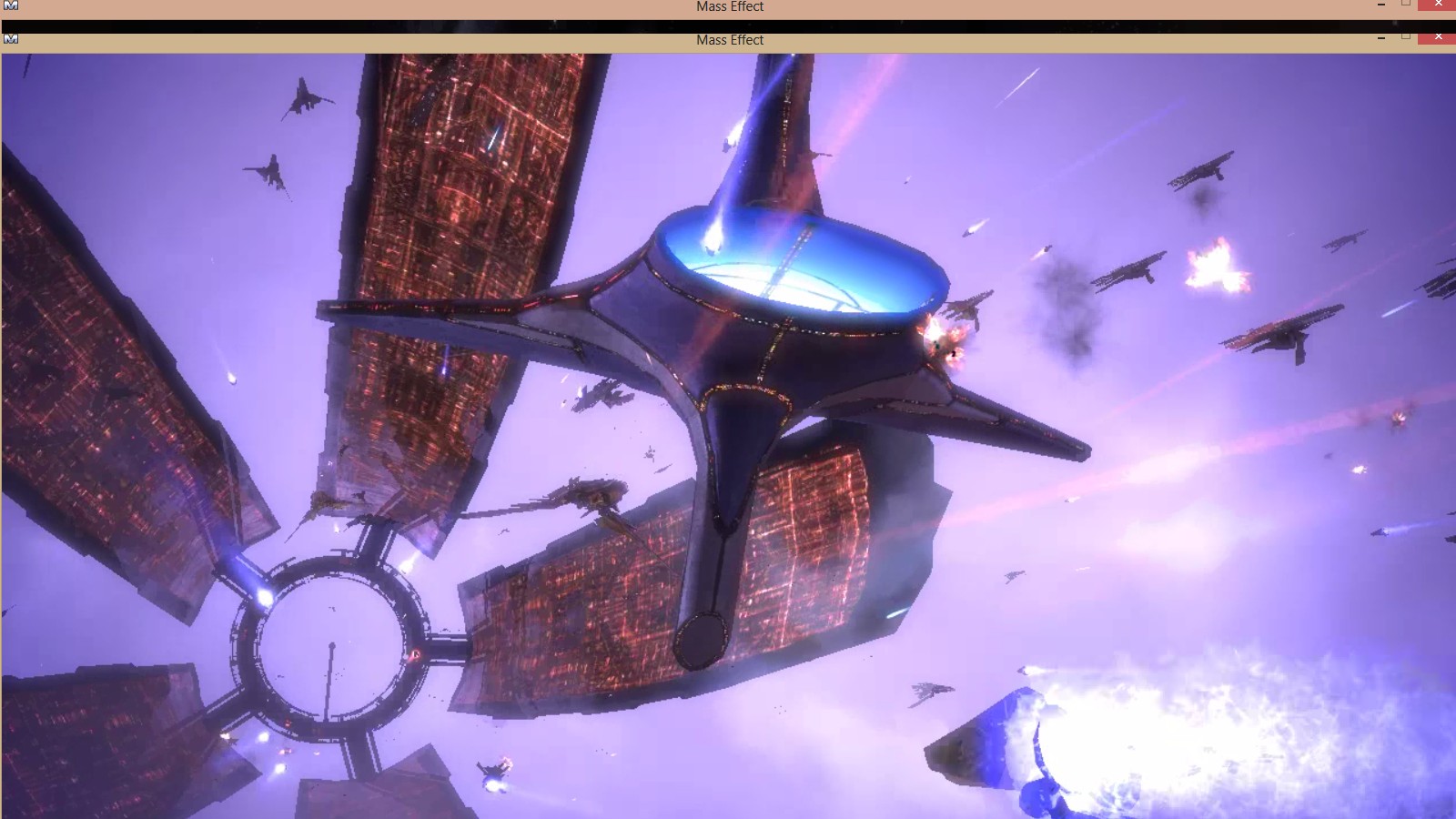 |
| While this is not a space combat game, there are some amazing cutscenes. |
 |
| Ashley, a compassionate, yet hot-headed infantry soldier is one of many outstanding NPC's with which you experience the game. |
 |
| Scenes like this never get old. |
Subscribe to:
Posts (Atom)