Showing posts with label forgotten realms. Show all posts

Sunday, March 27, 2016

Review: Ashes of the Tyrant by Erin Evans

Having aided Raedra and saved Suzail from conquest, Farideh and her family venture to a land that weighs heavily on her and Havilar's upbringing, despite them never setting foot there: Djerad Thymar, the center of dragonborn culture in Faerun.  While the tale begins as a simple answer to a summons, the family quickly becomes swept up in the mysterious murder of a dozen young dragonborn.  All the while, Dahl is on the other side of the world, coming to grips with the fact that he might never be able to see Farideh again--the price of saving his family.

I'm of two minds on this book.  On one hand, this book does more to establish the culture of Faerunian dragonborn than any other work yet published by Wizards of the Coast.  Evans' dragonborn society is rich in tradition, history, and culture, and this book really dives into it.  You learn about the high politics of how leaders are chosen in their militaristic society, and how that tightly interfaces with how the daily lives of individuals play out within their complicated family structures.  It's a society that feels fresh and unique, distinct from anything I've seen before in the Realms (and probably elsewhere).  It's tight and detailed, and is brought alive with small details, expressions, and mannerisms unique to the dragonborn.  And yet, it still leaves room for individuals to distinguish themselves from others or, at times, reject the dragonborn society altogether.

On the other hand, in the end, I can't help but feel like not a lot really happened in this book.  There is an immediate concern in the novel, and that is ultimately solved.  And along the way, there are dozens of small plot points that are introduced, some of which grow in stature such that they loom very large by the novel's end.  But ultimately, the book seems largely there to set up the story in the next, which (if I'm understanding correctly) may well be the ultimate book in this series.  Some of this problem in direction may stem from the fact that apparently about half of the critical events in this book were dictated by the game designers and their publisher.  The story Ms. Evans really set out to tell is what will be in this next book.

I did enjoy the book. But the more I think about it, the more I think that the interventions of the WotC team really did hurt this novel.  It doesn't have the tight, satisfying feel of Fire in the Blood, and as a result it's not a strong a book.  Nevertheless, that doesn't dampen my enthusiasm for the series or its characters, and I'm very much looking forward to the next book in the series.

Saturday, April 4, 2015

Review: Vengeance of the Iron Dwarf

The Silver Marches at war.  All three dwarven citadels are surrounded by the massive many-arrows army of orcs and goblins, bolstered by drow from the underdark.  Sundabar and Nesme have fallen.  Silverymoon and Everlund are under siege.  Drizzt and his companions made it through the siege to Mithral Hall, but not before being separated from two of their friends: Regis and Wulfgar as they made their way through the Underark.  Food is growing scarce, the alliance of elves and dwarves seems shattered, and the drow plans for the surface seem unstoppable.

The backdrop against which Vengeance of the Iron Dwarf opens is bleak indeed, and it sets the stage for a book with a vast, epic story in which massive armies come to bear on one another.  This novel, in many ways, resolves the war that has been brewing the past several books between the Many Arrows tribe and the good peoples of the Silver Marches.  As one might expect for a Salvatore book, Drizzt and his friends are right in the thick of it, though are not necessarily the biggest players in the gambit this time around.  The action is far-ranging and unquestionably epic, and some parts of this book are Salvatore at his finest.  He writes of huge, vivid battles that turn on key moments that, usually, feel real and exciting.  The descriptions of hardship under siege were also painfully real, and brought a tremendous sense of urgency to the events of the story.

There are some new characters and plot lines that develop in this book, but this is a book about tying up loose ends.  In that way, it's pretty satisfying.  The events were unquestionably memorable, and I look forward to seeing their ramifications written and described in a future Forgotten Realms Campaign Guide.

I did feel, however, that the book was lacking some multidimensionality.  Tiago, the primary villain in this book, seems like little more than a one-dimensional thug.  None of the villains, in fact, had a lot of depth to them, with the exception of one character who is developing into a potentially interesting character.  Some of the protagonists, similarly, just seem bland at this point, and too "good" at everything in comparison with standard mortals.  The focus of this novel is more about resolving the conflict than character development, but my hope is that we see something deeper with the characters in the future books of this series.

In the end, this book is a worthy finale to storyline of the past three novels.  It's a fast-paced, fun read, with some fantastic, memorable moments that I look forward to reliving with the Sundered book club over the coming weeks.

Thursday, February 26, 2015

Review: Elfshadow by Elaine Cunningham

Arilyn Moonblade is a half-elf assassin.  Or, perhaps, Bounty Hunter might be the better term.  Almost unequaled with the blade, she works contracts for a number of shadowy organizations, most prominently among them the Harpers.  But recently, even as she successfully dispatches agents of the Zhentarim, someone else is hunting Harpers.  For each Zhentarim who falls, it seems, so too does a dear ally.  And worst of all, despite not knowing anything about it, signs are starting to point to Arilyn.

Elfshadow was my first Elaine Cunningham novel, and it apparently was her first set in the Forgotten Realms.  I think the thing that stood out to me the most about this book was its characters.  Arilyn is a great character: focused, ruthless, impatient, and stubborn, but still possessed of a strong moral compass.  Along the way she is joined by Danilo Thann, a bard of significant magical skill who spends his time posing as an aloof dandy.  The two make for an unlikely pair, but the fact that they are almost forced into companionship by the events of the story results in surprising synergy, in addition to some genuinely hilarious moments.

I found the plot to be interesting, even if a bit convoluted.  It delves into a lot of backstory about tensions between races of elves within the Realms, which was really interesting to learn about.  I've read my share of Realms books, but distinctions between Moon Elves, Sun elves, etc, have never been given much attention in those books.  The story made sense, but I will confess to occasionally having some trouble following it.  I also thought that Cunningham's writing ranged from excellent to a little bit clumsy in some areas.  I'm no genius with prose, to be sure, but I did feel that she had a tendency to overuse certain writing patterns.  For example, she often referred to Arilyn as "the half-elf," which works a few times per novel but not the dozens of times it was used here.

Overall, it was a fun read.  I'm probably going to read a few more of her books in the coming months at the suggestion of a goodreads friend, and I'm looking forward to seeing if these characters continue to appear.

Sunday, November 30, 2014

Swordflight, Chapter One, Review

Hacking up rats has never been so much fun!
With dreams of glory, wealth, status, or other motivations, you arrive in Calimport and enter a tavern in search of work as an adventurer.  While early jobs are rather mundane--rat hunting and the sort--you quickly find yourself in the company of another would-be adventurer and on your first well-paying assignment: caravan escort duty in the Calimshan Desert.  That job, minor as it might seem, is what ultimately results in your entanglement in plots that involve bandits, undead, and even extra-planar beings.  Here are my comments to rogueknight333, the author of Swordflight, Chapter One:
I really enjoyed your module.  The story might not sound original on the surface, and employs a lot of fantasy tropes, but it's well-told.  As you mentioned below, it's clear that you try to put a twist on all of the fantasy tropes that you wield.  The result is a fresh and engaging tale that got my youthful adventurer off the ground and on his feet in tales fit for bards.  The entire module is meticulously polished, and was a blast to play through.  
Mysterious desert ruins!
Combat is most definitely very challenging.  Heeding your warnings about combat difficulty, I brought a level 2 fighter/rogue that I had from another module into this game.  The module seemed very well-balanced for him.  In fact, in a lot of ways, the module seemed custom-made for my character.  I've never made so much use of usable items like choking powder, potions, etc.  And because he had good use magical item ability, he was also able to make heavy use of magic wands against foes.  The result was a really dynamic combat experience that I found really enjoyable.  My character would probably do better if he had a henchman to tank for him, but he held his own.
Thanks for the fun module!  I'm eager to see what the next chapter will bring for my character and his companion!
Hmm...what's this?

Monday, November 24, 2014

Review: Fire in the Blood by Erin M. Evans

Having survived the Shade's internment camps and come to grips with the missing years in their life, Farideh and Havilar travel to Suzail, capital city of Cormyr.  There, they hope to give Brin time to work out the problem of his engagement to the Princess of Cormyr, Raedra Obarskyr.  At the same time, Farideh must wrestle with the recent discovery that she is a Chosen of Asmodeus, and the terrible power that comes with such an arrangement.  Dahl and Vercaras also are in the city, and hope to investigate the disappearance of one of their Harper operatives in the city.  But hoping for any respite to get one's bearings proves impossible, for Cormyr is at war with the Shade, and life in a country at war is anything but predictable.

Fire in the Blood is my second Erin Evans book.  I began reading with The Adversary, which I thought was excellent.  This book, however, was another step forward.  The challenge in the Adversary was largely one of isolation.  This book, however, puts Fari and Havi at the center of a vast conflicts that erupt not just among political factions within Cormyr, but also between the nations of Cormyr and Netheril.  

All of the major characters undergo a great deal of development in this book.  Havilar must wrestle with the strains that reality place on her now-adult relationship with Brin, who is pulled between duty to his country and his love of Havilar.  Farideh must continue to struggle with her relationship with Lorcan, the half-devil, and the question of whether to pursue it as a romance or write it off as nothing more than the pact.  The character, however, who really surprised me in this book was Dahl.  After returning, unexpectedly, to field operations in the Adversary, Dahl is back in full action in this book--and proves time and again to be exceptionally good at his job.  He continues to be plagued by his fall from paladin-hood with Oghma, but his regrets over his past no longer smother him.  In fact, he often thrives, and may be the most effective character in the book.  We are also treated to a full development of Princess Raedra, who proves to be a nuanced, powerful figure in her own right, with no shortage of humanity.  In many ways, this book is her story, and it's worth every page turn.

As with the Adversary, all of this goodness is rooted firmly to Forgotten Realms lore, both on Toril itself, as well on other planes, including the nine hells.  There are nods to current events in the realms, including the current Tyranny of Dragons storyline.  There are also references to events in other recent Realms books, such as the siege of Marsember in Troy Denning's The Sentinel and the future massing of armies to attack Myth Drannor, as told in Ed Greenwood's The Herald.  I also found neat connections to other Realms stories that I'm reading.  For example, Raedra made mention of Alusair Obarskyr, the Steel Regent, a prominent figure in Cormyr's history.  She also made an appearance in Tiberius's Neverwinter Nights module, Saleron's Gambit, which I was playing as a read this book.  It is these kinds of connections that makes reading and playing in the Forgotten Realms so much fun.

This was the best book I've read all year long, and I've had a lot of fun reading this year.  Highly recommended to everyone.

Thursday, November 13, 2014

Saleron's Gambit Review

This is one of many posts I've made on Saleron's Gambit.  As the last "review" I made was for Chapter III of the series, I'll begin by assuming that module as background.  The series is available as a combined download on Neverwinter Vault, so this post focuses on chapters IV and V.  If you'd like to read my thoughts on the first three modules, they can be found here: I, II, and III.

Chapter V features some amazing tilesets.
Having located Natalya in Chapter III, you have learned of how the two of you, along with Saleron, are linked by your murdered parents.  Now united in your goal to rid yourselves of the sinister threat imposed by the Dread Lord Vraxilom, you travel to the remote island of Ajit-Kuhn to find instructions for a ritual that might free you.  Little did you know that it was there that you would finally come to learn the greater truth about your parents, and ultimately make your mark on history.  Here are the comments I left on the Vault's module page:

This was a terrific module series.  The story begins as fairly traditional "Farm Boy Rises Up" tale in the early modules, but gradually goes far deeper.  The story becomes increasingly complex, but it is told in a way that makes it both approachable and, most importantly, personal.  I think this is ultimately one of Tiberius's great strengths.  He allows me to connect with stories on an emotional and personal level.  His NPC's are well-realized,  his locations richly presented, and the story is well executed.  But he keeps the focus squarely on the player character and his place in the story as well as any other module author. 
I'm never above some goblin smashing.
I loved that this series is, in some ways, an homage to some of the great Infinity Engine games of the past.  Areas, events, and characters from Baldur's Gate II appear prominently in chapter III and, more ephemerally, chapter IV, whereas parts of Chapter V take strong inspiration from Planescape: Torment.  Moreover, it is extremely well-grounded in published lore of the Forgotten Realms, again featuring numerous appearances from known NPC's, areas, and even plot ideas that have been published over the past decade.  In a favorite example of mine, the Steel Regent, Alusair Obarskyr, makes a prominent appearance in Chapter 5.  What's great is that I'm currently reading Erin Evan's terrific Fire in the Blood, and the very night I encountered Alusair this module she (or her ghost, rather) appeared in the book.  This is why I love reading and playing in the Forgotten Realms!

It also is an important module because of its emphasis on low-power gameplay.  While there are a handful of magical artifacts in the game, they are rare and well-prized.  Your character's innate abilities, along with consumables like potions, are what ultimately make the difference for your character when trying to survive through his modules.  Combat in the last two modules was very well-balanced for my melee-oriented bard, who could use his buffing spells and abilities to overcome his native weaknesses in attack modifiers and HP.  I'd guess that it would work well for a fighter-type as well, as long as you made aggressive use of potions.  Wizards and Sorcerers, provided they can survive the first module, really would seem to shine in this game.  Their spells would largely be unmatched by your non-magical opponents, and you will do battle with several magical casters that prove very potent opponents for those without a good way to penetrate their defenses.


The module features fantastic, cinematic cutscenes.
I've played both this series and the Maimed God's Saga.  Both are excellent, but I think the tone of the two modules is different.  Maimed God is very mature, gritty, and serious.  Saleron's Gambit, on the other hand, is a bit more jovial and lighthearted, despite the fact that it is quite challenging.  The villain in Saleron's Gambit, for all his power, is a bit of a buffoon, and is quite a contrast from what you fight against in Maimed God.  Nevertheless, the story itself is gripping, and just becomes more and more interesting as you move into chapters IV and V.  I'm glad to have finally had the chance to play it all the way through.
More screenshots after the jump!

Friday, September 26, 2014

Rise of the King by R.A. Salvatore

Having tied up some loose ends in Night of the Hunter, Drizzt and his companions begin their trek toward Mithral Hall.  There, Bruenor hopes to reclaim his throne and rectify what he views as his error in permitting the orc king of Many Arrows to establish a peaceful kingdom that borders the Silver Marches.  Little do they realize that the Drow are already moving, and war is coming to Luruar.  Orcs, giants dwarves, elves, men, and even dragons clash in this book of conflict and struggle.

This is among the most enjoyable Salvatore books that I've read, and in my view is definitely the best of the Sundering era.  The action is fast, furious, and epic.  While other books have featured exciting, small squad skirmishes, this one gives us those as well as epic battles for the fates of cities.  On top of the battles, we are treated to reconnaissance, espionage, and another hearty helping of political machinations among the Drow.

Regis, who in many ways was the star of The Companions, took something of a back seat in Night of the Hunter.  In this book, however, he was back to playing a central role, and in my view has easily become the most dynamic and interesting character in the crew.  Furthermore, while Jarlaxle spent Night of the Hunter reacting, in this book he seems to be back on the offensive.  As we might expect, of course, exactly what he's after still has yet to become clear.  Beyond those two, I'm not sure that we see a lot of significant character development, aside from some continued discussions between Drizzt and Catti-brie on the inherent nature of orcs and goblins.

I really enjoyed the book, and will, of course, look forward to reading the next in the series when it is published in 2015.

Monday, August 25, 2014

The Black Scourge of Candle Cove

Welcome to Candle Cove, Docks District!
My character: level 10 wood elf ranger, who has played through Avendale and (some of) Misery Stone.  Advanced to level 13.
Time: About 20 hours.

A villainous sea hag and her band of ogre pirates has shut down the lighthouse of Candle Cove, and that, along with the formidable firepower of her ship, shut down all trade out of the lucrative harbor of Candle Cove.  You have just arrived in the town as a traveling adventurer, and decide to answer the Mayor's call to help out the town.  What follows is a challenging, engaging adventure that combines a fairly linear main plot (though with some choices) with a decent sampling of sandbox-style adventure in its sidequests.  Here are my comments to the author:
Dive!  Dive!
I finished last night and I really enjoyed the adventure.  It's an engaging story with a lot of great flavor mixed into the module, and more gameplay than I anticipated when I began the module.  While the adventure itself doesn't really claim to be a "pirate adventure," in that you're going after the pirates and not living as one yourself, there's a lot of those themes mixed into the setting.  A lot of the foes you encounter use "pirate speak" to great effect, especially as flavor text as you fight them.   Candle Cove is a great port town, and I appreciated the innumerable small things that were done to add depth, immersion, and entertainment to the setting (also, my daughters greatly enjoyed the names of the horses near the magic shop).  It's also a Forgotten Realms module, through and through, with a lot of attention paid to backstory coming from that setting.  The Temple of Sune is probably the most direct example of this, which was a far cry from the variety of Sune worship from Harp & Chrysanthemum (and, in truth, probably more in keeping with the lore).  Nevertheless, from the backstories of the companion characters to the items, there's a lot of other lore that works its way into the game. 
Well, hello!
Area design is spectacular.  The city of Candle Cove itself is a delight to navigate, but the most spectacular areas are unquestionably the underwater areas.  I've seen underwater zones implemented in other modules--mostly NWN1--but never as well as was done in this module.  There is also a huge, underwater cavern that you get to investigate that also has to be on the shortlist for spectacular exterior area design.  The entire module is a visual treat, and your ears get treated to a nice selection of nautical themes. 
Combat was very challenging for my two-handed ranger.  While he may have been a bit underpowered when he began the module (he was dual-wielding +1 weapons), he seemed a pretty good match for the companions that are provided in the game...and, after he finished his first small adventure near town, he was quickly able to upgrade his weapons from the more-than-ample selection in the various stores around town.  By the module's end, he was dual-wielding +5/+4 weapons, with some +6 bracers, +3 to all saves, some elemental resistance, etc. I didn't give the companion characters quite as much attention, but they were still very well equipped for level 10-11 adventurers.  Nevertheless, despite being pretty decked out, the final part of the module proved extremely challenging.  This was clearly by design, because you battle through hordes of weaker foes before being faced with a set of very challenging enemies with some key resistances.   It was always possible to survive, and I don't think I ever actually had to load from a save, but it required a lot of buffing, item use (summoning!), and consumption of healing pots and kits to make it through.
Overall, it's an excellent, polished, engaging module that definitely falling into the must have category.  Congrats on the module, and thanks for giving it a release!

Custom UI pop-up boxes!  ...although these eventually
seemed to stop working as the module
went on.
As a note to other players, the module gives you import your own part, make use of the provided companion characters, or do a mixture of both.  I opted to use his companions, but if I were to do it again I'd probably have brought my own wizard along (a pre-existing level 10 character already in my vault).  The characters definitely have some dialog, and one (apparently) has a side quest that I didn't find, but they're far from essential to the experience of the module.  If you were to use one of Tchos's characters, though, I'd definitely recommend the rogue.  She has some great dialog of her own, and knows a few people around town that you'd otherwise never get to meet.

More screenshots after the jump!

Thursday, July 31, 2014

Tales from the Lake of Sorrows

My Character: level 1 Blessed Soul, reached 13 (almost 14) by the module's end.
Time Played: ...50 hours?  More?
My Vote: 10 - A Masterpiece, Genuinely Groundbreaking


A delightful little hamlet seen early in the game
As a would-be adventurer just starting on your way, you arrive at the small village of Lakeside that is in need of someone to help solve a mystery.  After teaming up with a vagabond of questionable background (Ember), you begin your investigation.  Quickly, you become embedded in a complicated plot that involves dozens of key players: lords, commanders, clerics, wizards, cultists, and no small number of innocent bystanders.  What follows is a module of incredible breadth that rivals the official campaign in both both length and scope.  By the time you finish, you really have lived the life of your character, and impacted innumerable non-player characters and their families.

How did I get myself into this?
The core Tales from the Lake of Sorrows is its story.  It is a fairly linear game, and PJ makes this clear from the outset in the module description.  There often are a number of intricate and interesting side-quests.  Nevertheless, the area designs are such that they are often more or less on rails, and many do not encourage exploration.  But that's really ok: if there is anything lost by its linearity, the module more than makes up for it with its story.  It is a complicated tale, but the pacing throughout is excellent.  PJ's masterpiece is set in the Forgotten Realms and focuses on small, rural villages where a hero could really make a difference.  As with villages in real life, you meet many key families that have deep roots in the rural society.  I loved that these characters were recurrent throughout the adventure, so that some that you meet in the first couple of chapters show up repeatedly in later chapters, often providing new insights into their sordid histories.  That's not to say that the entire module occurs "in the sticks."  As you progress, you travel to prominent cities...and to even stranger realms.

You receive up to five companions in the game, and none of them will travel through the entire game with you.  Companions enter the story as circumstances allow, and at times they are pulled in different directions and must take their leave.  Most of the time, they do return to adventure with you at some later date...often when other companions are called elsewhere.  All of the companions have interesting backstories, and most become critically engaged in the plot.  The relationships you cultivate while adventuring with your party drive a lot of your character's engagement in the story.  There is a romance available with one of the companions.  While I'm often not particularly excited about in-game romances, I found this one to be very well done.  You grow together gradually as you play, and the relationship is one of maturity between adults as opposed to teen-style crush romances that are sometimes featured.  Roleplaying opportunities are very strong in the game.  The dialog options provide you with real choices that allow you to shift between a heroic crusader to for-the-money mercenary without much trouble, and your choices can have impacts on how the campaign plays out.

Combat is also really well done.  While I would never say that this isn't a combat-intensive module, there is very little filler here.  Virtually every combat has a purpose.  It might be a major setpiece battle between yourself and a known villain, a raid on a large enemy fortification, a trench-to-trench battle to re-take farmland from an army, or even a minor skirmish between guards outside a keep or cave hideout.  You almost never fight the same group more than once, and it all makes sense in the game world.  Furthermore, often times, there are significant tactical considerations in these fights.  One really can't just run in and mash your way through, especially as you approach the end of the game: you need to use tactics, make careful choices of spells, and keep your spellcasters and archers safe behind your tanks.  My blessed soul was a great match for the game: he focused on buffing spells to keep his fighting ability on par with a fighter, and provided healing, restoration, and spell protection as needed.  There are no cleric-type companions, so if you do not bring one with your NPC you will need to be aggressive about purchasing potions of healing, restoration, etc.

Taking the orc fortress
Finally, I do need to take a moment to commend PJ on his area design.  This module is one of the most visually spectacular that I've ever played, and I took a TON of screenshots where I found myself marveling and saying "wow!"  There are a lot of areas in this module, and some are only experienced briefly.  Nevertheless, all of them are crafted with care and skill.

Critiques: I don't have many.  The biggest is probably that, no doubt due to the sheer volume of dialog and custom item descriptions in the game, there are a fair number of typographical and grammatical errors.  Some could be caught with a spellcheck plugin, whereas others would just take a lot of proofreading time.  That said, the writing is great in flavor, feel, and emotion.  The journal also seemed to get a bit "wonky" as I progressed through the game, with several entries from the first chapter, in particular, that were never completed and cluttered up the journal throughout the rest of the module.

In any case, this module is a really impressive achievement.  It's a dramatic, thrilling story that will immerse you in a wonderful cast of companions, allies, and villains.  And best of all, there's more to play: PJ just released out with the next chapter in his series, The Soul Cages - Chapter 1: Loose Ends.  Furthermore, there's a companion module to Tales called From This Comes Strength, which tells the story of what happened to one of the NPC's while she was away from your group.  I'm eagerly looking forward to playing both modules.

Many more screenshots below the jump! (with minor spoilers)

Wednesday, July 30, 2014

Review: The Herald by Ed Greenwood

While the events of the other Sundering novels occurs, and while the deep-pocketed Netherese march on the elven city of Myth Drannor, Elminster and his close allies are instead focused on a smaller, yet no less important task: traveling from site to site around Faerun and strengthening the anchors between the Weave--the field of energy from which all arcane magic is derived--and Faerun.  Such subtlety cannot last long, however, and soon the heroes are wrapped up in a mighty struggle that spans across much of western Faerun.

The Herald is a fast-paced action novel that tells a critical story within the events of the Sundering.  While many questions go unanswered--indeed none of the novels really address the issue of Toril separating from Abeir, in particular--it is nevertheless a fun and fascinating romp through many classic locations within the Realms.  This was my first Ed Greenwood book, and from the reviews and comments I've seen it is one of his best.  Yes, the dialog, the battles, and the themes are often over-the-top.  But it's a really fun ride, and showcases two treasured areas of the realms: Candlekeep and Myth Drannor.  The pacing is superb throughout, with twists and turns that have me oscillating between despair and exhilaration at the author's whims.  It's not quite to the extent of a G.R.R. Martin story, but there are enough ups and downs that it appears no one--and no where--is completely safe.  The book had me up late turning pages many nights.

As someone new the Ed Greenwood's books, I found it pretty easy to step into the story.  I did find it helpful to hop onto the Forgotten Realms wiki to better understand a few of the characters after completing the book (especially the Srinshee!).  But even without doing that, I had little trouble following the story and understanding the stakes.  It's a good place to jump into Greenwood's series, and a fun wrap-up of the Sundering novels overall.  Having read the entire six-book series, I am eagerly looking forward to the Forgotten Realms campaign setting guide for 5e to get a more comprehensive overview of what has happened to each location.  It will be fun to read about each location that we've visited over the past six novels.

Wednesday, May 28, 2014

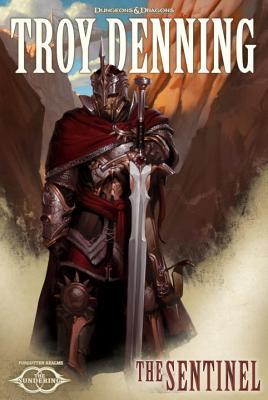
The Sentinel by Troy Denning

In the midst of the invasion of Cormyr by Sembia and the Netherese, Kleef Kenric, a guardsman of intermediate rank in Marsember, finds himself caught in the middle of a conflict involving the gods themselves.  He encounters Arietta Seasilver, a young noble, as well as a pair of surreal characters with mysterious motives: Joelle Emmeline, a chosen of Sune, and Malik, and chosen of Myrkul.  Together, they take part in a grand adventure, ranging across much of Faerun in their efforts to save Toril.

The book begins extremely well.  We are treated to thrilling action at a breakneck pace that feels invigorating and fresh.  We haven't had the opportunity to experience life in a large city thus far in the Sundering series, and this book begins squarely in Marsember during a time of crisis.  The characters present themselves as capable, but still vulnerable, with plenty of room for development.  Furthermore, the plot is full of potential and mystery.  There are great concepts as well, like the idea that one interprets the actions of the gods based on one's own internal belief system.  It's great.

Unfortunately, at least in my view, as the book passed the half-way mark, it seemed to stumble.  The characters, which began so well, became more shallow and less dynamic.  Interesting characters entered and then left abruptly, often without much in the way of resolution.  The plot continued at a break-neck pace, and somehow that became a problem as we went.  The danger level never really declined, but the heroes seemed to have less and less trouble with their challenges as they went.  Sometimes, their actions seemed at odds with the apparent gravity of the situation they faced.  In short, it just didn't work.

I'm not sure what happened here.  Maybe the book was rushed.  Or maybe there was just too much story here to tell in the space that Denning was allotted, and they didn't cull it down sufficiently.  It's a shame, because the book began so well and had so much potential.  In light of how good the first half was, I'm giving it a 3.

Tuesday, April 15, 2014

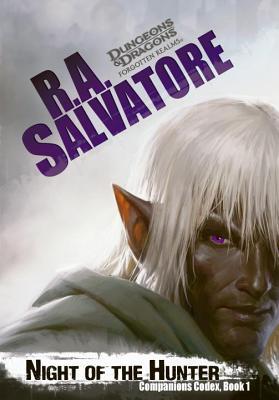
Book Review: Night of the Hunter by R.A. Salvatore

Night of the Hunter continues the Drizzt's story as he finally reunites with his companions and gains a new lease on life.  Simultaneously, it tells the story of a major move by the ruling houses of the drow--and, by extension, Lolth--to consolidate their power in Menzobarranzan, and ultimately bring conflict to the surface world.  And while that's happening, we also have the story of Artemis Entreri and his companions as they piece together what to do with themselves now that Drizzt has left them.  As one can see, there's a lot going on here, and it's only as the novel reaches its conclusion that the disparate threads coalesce into single narrative.

The best part of this book is unquestionably the interesting look into drow culture.  It tells the story of how the ruling matron mother, apparently guided by Lolth herself, is able to thwart the many schemes of her rivals while simultaneously bringing them under her command.  While I'm not a big fan of drow, I really enjoyed this component of the book.  I've often wondered how a group of such conniving, backstabbing people could still somehow achieve a structured society.  This book provided a great look into a way that it could work, at least with the help of their horrible goddess.

Having survived a close brush with death, and finally in the company of those he loves most dearly, Drizzt seemed surprisingly passive in this book.  He does his share of swordsmanship, of course, but largely seems to take a back seat to the immediate needs and desires of his friends.  And it makes sense: he's so overjoyed to see them that I can imagine him wanting little more than to spend time with them.  The result is some thrilling battle sequences as they venture into Gauntlgrym, along with some delightfully cheery character interactions scattered throughout the book.

There was one place where I found myself disappointed, however.  I've seen Bob Salvatore talk about how the Sundering is an opportunity to return to the classic, simple, black-and-white of the past.  He seems more comfortable in that framework, but to me it is the gray that has made his more recent books so interesting.  I was particularly saddened to see his star characters dismiss the notion that a certain race of humanoids might not be, at their core, destined for evil.  Drizzt himself struggles with this notion throughout the book, but I'm hopeful that future books will show at least some exceptions to this rule.  Worlds are more interesting when there are shades of gray, rather than the strict black and white of humans vs. monsters.

That all said, it was a fun book to read.  It's not my favorite of R.A. Salvatore's books, but it sets up a pretty interesting scenario for his future books to explore.  I'm looking forward to the next one.

Monday, March 17, 2014

The Reaver by Richard Lee Byers

The Reaver manages to combine almost non-stop action with interesting character development.  The story revolves around the journey of Stedd, young boy who is the chosen of reincarnated Lathander who made a minor appearance in Erin Evans' book, The Adversary.  Stedd is on a mission to Sapra, but is opposed by Evendur Highcastle, a grotesque, undead pirate raised by Umberlee as her Chosen.  As the book begins, Highcastle has put out a bounty on Stedd, which all manner of scum seek to receive...including the main character of the book, a dastardly pirate named Anton Marivaldi.  What follows is an interesting character journey in which Anton almost accidentally finds himself wrapped up in conflict surrounding the boy, Stedd, and ultimately undergoes a gradual, believable transformation.

The characters are really central to this story.  Anton is a fascinating character, a man who committed himself to impulse and greed who is suddenly faced with what to do with a boy of virtually pure goodness.  There is also Umara, a brilliant Red Wizard of Thay, and cunning illusionist, and servant to a powerful vampire lord, Kymas.  And finally, there is Evendur Highcastle, a bloated, rotting corpse reanimated to channel the power and machinations of Umberlee.  It's a great cast, and I'm hopeful that we might someday see a sequel or spinoff to see what happens to some of the survivors.

This book is the 4th in the Sundering series.  One can argue that it is the most "Sundering-y" of the bunch thus far. Whereas others hint at the machinations of the gods above, and we see Chosen struggling against one another to further their own goals and those of their dieties, The Reaver features battles among chosen on a grand scale.  The entire book is set during the time of "The Great Rain," a period of endless rain that pounds the Sea of Fallen Stars and the nations that border it.  The rain permeates everything in the novel, and its origin and meaning--natural, or divine--is one of its great mysteries.  Furthermore, more overt divine magic permeates the book, and we are treated to epic sea battles as the forces of Umberlee clash with those of Lathander, Silvanus, and the wizards of Thay.  And on top of all of that, there's everything one could hope for in a tale of buccaneers: infiltration, swashbuckling, sabotage, and ship-to-ship combat, all with a sprinkling of fantasy magic.

I had some minor criticisms.  The last third of the book seemed, at times, a bit less polished than the first two thirds.  But the book features so many points of high drama and excitement that I have no hesitation in giving it a strong review.  It's a great read, and one of my favorite Forgotten Realms novels.

Saturday, February 8, 2014

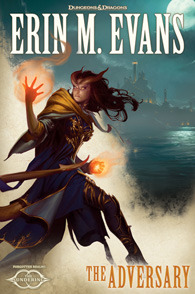
The Adversary by Erin Evans

I heard the author of The Adversary, Erin Evans, describe the premise of her book as this: Farideh, the central character, makes a very bad decision early on in the book. She then spends the rest of the book dealing with the consequences of that decision.

It's a terrific, spoiler-free encapsulation of the story. What I didn't realize heading into this is that the consequences arrive on many fronts. Immediately, her decision has dramatic consequences on the people she holds most dear: her inner circle of family and friends. But the consequences of her choice extend much further. They interface with vast plots that entangle her personal story with events that threaten to affect the balance of power not only in the mortal realm, but the realm of the Gods as well.

I really enjoyed this novel. The core characters of the book were all distinct and multidimensional, and most undergo substantial character development. There is a lot of gray here: there are flawed heroes, and there are characters who would be villains in most stories, but here are forced to become allies of good. The plot had good pacing, always seems to move at a fast clip. Finally...there was a great deal of subtlety in the novel. While it was not blatantly (or manipulatively) deceptive, we often were presented with incomplete information. Only later did we learn complete story. More so than any of the other Sundering novels to this point, I think this is one that I'd gain the most by reading a second time.

One thing I really like about the author's style is how different her narrative feels depending on the point of view from which she is writing in a given chapter. Sometimes, for example, we're treated to an interaction between Farideh and Lorcan, her devil patron, presented from Farideh's point of view. Later, however, we get treated Lorcan's perspective as he thinks back to that event. Needless to say, their interpretations of the events are often radically different.

I don't have much to criticize. Like Godborn, I noticed a few small editing mistakes here and there. One time, for example, I think "Brin"'s name showed up as "Erin," which was amusing. But really, reading this was such a pleasure. I'm really looking forward to Erin Evan's next novel.

Edit: Turns out the Brin for Erin thing was the result of "kerning."  I am henceforth opposed to Kerns of any kind!

Monday, December 2, 2013

The Godborn by Paul Kemp

In many ways, The Godborn was vastly superior to R.A. Salvadore's The Companions, the book that preceded it in the Sundering series.  It is only loosely connected, which was as expected.  What was unexpected was how easy it was to step into Paul Kemp's world.  I hadn't read any of the previous Everis Cale books.  Aside from spending some time reading Kemp's excerpts, and then looking up some of the names and characters on the Forgotten Realms Wiki, I had no experience with any of the preceding content.  Nevertheless, I found this book very approachable and easy to dive into.  In fact, I read the vast majority of it in a four-day span over Thanksgiving.

The summary: it's very good.  It has excellent pacing.  Despite the fact that much of the first two thirds of the book is largely preparatory, the whirl-wind, stunning last third of the book manages to wrap up most of the innumerable apparently disjointed threads introduced early on without seeming rushed or anti-climactic.  Kemp writes excellent dialog and presents some wonderfully believable characters.  In contrast with the chaotic but wonderfully energetic battle scenes that Salvadore composes, Kemp's combat scenes are far more cinematic and visually descriptive.  It begins as a very gritty, down-to-earth book, but as it moves along the action rises to grander and grander scales.  It was hard to put down, and never felt slow.

In the end, we have a very satisfying conclusion to a saga that I only know in part.  As excited I was to see it end, I can only imagine what someone who has read all of the Cale books must feel at its end.  It was riveting from start to finish.

I do have a few critiques.  First, the book does have substantial horror elements that are critical to the plot.  I'm not a big fan of horror, but I get it and it works for the novel.  There was one set of characters, however, that seemed to be created strictly to pound one the reader's emotional heartstrings.  This is unfortunately very obvious from the start, and to me felt far too transparent.  Furthermore, while it sets up a tale of revenge, this is never really allowed to run its course in a satisfying way.  

Second, I was surprised to see a number of editing problems in the kindle version that I read.  There were several cases where words or sentences were spliced together incorrectly.  Furthermore, there were some plot inconsistencies.  At one point, Vasen loses an important item to the Shadovar.  Then, later, the book mentions him using it again, only to later remind us that the Shadovar have it.  I wasn't the only one who noticed either--my Kindle noted that three people had underlined both of those passages.

Still, it was a great book.  If the first two thirds were a 3-4 star, the brilliant conclusion easily justifies a 5-star rating.  I'm not sure if we'll see more of Everis or Vasen Cale, or their surviving companions.  But if so, I will gladly and eagerly read on.

Saturday, November 30, 2013

The Companions by R.A. Salvadore

Some minor spoilers below, mostly from the first few chapters of the book.

The Companions was quite a surprise.  I left R.A. Salvadore's story after finishing the Paths of Darkness's final book, the Sea of Swords.  Wulfgar, now with an adopted child, had finally come to grips with his traumatic past and had taken steps to stride into his future.  He'd been reunited with the the Companions and found his great warhammer, while Drizzt and Cattie-brie had fallen in love.  I missed what happened next: the deaths of the Companions, and Drizzt's adventures with his new associates--those who did not share his morals and ideals.

Now, as The Companions begins, Bruenor, Cattie-Brie, Regis, and Wulfgar find themselves in a kind of strange pocket-plane created by Mielikki, a goddess of nature and the patron of Drizzt.  They are faced with a choice: do they continue on to their just reward, or do they instead accept a gift from Mielikki and be reincarnated on Toril, tasked to help Drizzt in his time of need.  What follows is the story of how those who choose to return are born and live through their early years once again.  It explores an interesting question: what would it be like to live your life again, having the memories, knowledge, and cognitive function of your prior life?

Each of the characters' new life story is faced with its own challenges, and in these we see each character grow and develop in leaps and bounds.  Their stories dominate this book--in truth, Drizzt gets far less screen time than the cover might suggest--and each has an eventful childhood and early adolescence.  By the end of the story, several are quite simply not who they were when the tale began.  Some of the individual plot-lines work better than others, but overall it is an enjoyable read...and a book that has me eagerly awaiting the next in the series.

A few specific comments (major spoilers follow!!)

Wednesday, August 7, 2013

More Sundering Movies

For some reason, I didn't see this at the DnD website, but the DnD Youtube Channel has two new videos about the Sundering books.  Not much new, but they're worth the quick watch.

(fwiw, I wonder about when the conference footage was filmed.  It pretty much has to be recent, because it has the most recent artwork for each of the characters plastered on the walls!)


Now, if you'll excuse me, I'm off to go read The Companions. ;)

Tuesday, June 18, 2013

Book mini-review: Sea of Swords by R.A. Salvadore

I've gotten back into reading over this past year, thanks in large part to my picking up the Path of Darkness book collection on a whim at a public library sale while attending a wedding in Milwaukee last August.  It cost me a buck.  I've read this collection of four novels in fits and starts ever since, and have read three other fantasy novels over that time.  But while I still am not overly fond of Drizzt the character, the supporting cast in Salvadore's books is strong, the pace is fast, and the action is terrific.  I'm sure that they are not fine literature, and there's no question that they are full of cliches and tropes.  But they are fun.  And that, in the end, is really what it's all about for me!

So...I thought I'd try my hand at penning a short book review over at goodreads.  And, since I'm writing it there, I figured that I should post it here as well!

I really enjoyed the Sea of Swords as the conclusion to the Paths of Darkness collection.  This fourth book in that series is an action packed adventure that sees most of the key story lines that began in the first three come to a satisfying conclusion.  We see Wulfgar, who decides to come to terms with his demons, and ultimately chooses to go on a quest to reunite with the Companions of the Hall.  Furthermore, we see those same companions set off on a quest to recover Wulfgar's enchanted craghammer, Aegis-fang.  We also meet new characters.  Sheila Kree, the pirate captain who purchased the stolen hammer earlier in the series.  Bellany, a powerful sorceress who works for Kree and a former companion of Morik the Rogue.  And we meet Le'lorinel, an elven assassin who has made it a life's mission to hunt down and kill Drizzt.

The book is full of action and adventure, punctuated by excellent character interaction.  There aren't a lot of major surprises, but there are a few--enough to keep you on your toes and turning pages.  The remarkable thing to me is just how satisfying the book, and the Paths of Darkness series as a whole, managed to be.  Between the Servant of the Shard and the Sea of Swords, virtually all of the major plot lines are brought to a close (one way or another!).  Though he obviously did not, Salvadore could have walked away from Drizzt novels at the end of this book, and I don't think anyone would have complained.  It's not that there isn't anywhere for these characters to go or develop.  As someone who has not read much of his subsequent work, I can imagine grand adventures to come for all of the (surviving) characters.  But the immediate concerns have largely been resolved, freeing these characters to venture into new adventure.  It was a fast and very enjoyable read.

While I am doubtful that I will read much of the intervening work, I am greatly looking forward to reading The Companions when released in August.  The sample chapter on Wizards' site, which I assume to be Drizzt's opening reflections, seems to pull heavily from the events in the series that I just completed.  It looks like I chose a great place to sample this vast storyline!