While the events of the other Sundering novels occurs, and while the deep-pocketed Netherese march on the elven city of Myth Drannor, Elminster and his close allies are instead focused on a smaller, yet no less important task: traveling from site to site around Faerun and strengthening the anchors between the Weave--the field of energy from which all arcane magic is derived--and Faerun. Such subtlety cannot last long, however, and soon the heroes are wrapped up in a mighty struggle that spans across much of western Faerun.
The Herald is a fast-paced action novel that tells a critical story within the events of the Sundering. While many questions go unanswered--indeed none of the novels really address the issue of Toril separating from Abeir, in particular--it is nevertheless a fun and fascinating romp through many classic locations within the Realms. This was my first Ed Greenwood book, and from the reviews and comments I've seen it is one of his best. Yes, the dialog, the battles, and the themes are often over-the-top. But it's a really fun ride, and showcases two treasured areas of the realms: Candlekeep and Myth Drannor. The pacing is superb throughout, with twists and turns that have me oscillating between despair and exhilaration at the author's whims. It's not quite to the extent of a G.R.R. Martin story, but there are enough ups and downs that it appears no one--and no where--is completely safe. The book had me up late turning pages many nights.
As someone new the Ed Greenwood's books, I found it pretty easy to step into the story. I did find it helpful to hop onto the Forgotten Realms wiki to better understand a few of the characters after completing the book (especially the Srinshee!). But even without doing that, I had little trouble following the story and understanding the stakes. It's a good place to jump into Greenwood's series, and a fun wrap-up of the Sundering novels overall. Having read the entire six-book series, I am eagerly looking forward to the Forgotten Realms campaign setting guide for 5e to get a more comprehensive overview of what has happened to each location. It will be fun to read about each location that we've visited over the past six novels.
Showing posts with label sundering. Show all posts
Wednesday, July 30, 2014
Wednesday, May 28, 2014
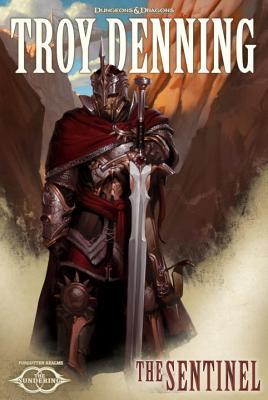
The Sentinel by Troy Denning
In the midst of the invasion of Cormyr by Sembia and the Netherese, Kleef Kenric, a guardsman of intermediate rank in Marsember, finds himself caught in the middle of a conflict involving the gods themselves. He encounters Arietta Seasilver, a young noble, as well as a pair of surreal characters with mysterious motives: Joelle Emmeline, a chosen of Sune, and Malik, and chosen of Myrkul. Together, they take part in a grand adventure, ranging across much of Faerun in their efforts to save Toril.
The book begins extremely well. We are treated to thrilling action at a breakneck pace that feels invigorating and fresh. We haven't had the opportunity to experience life in a large city thus far in the Sundering series, and this book begins squarely in Marsember during a time of crisis. The characters present themselves as capable, but still vulnerable, with plenty of room for development. Furthermore, the plot is full of potential and mystery. There are great concepts as well, like the idea that one interprets the actions of the gods based on one's own internal belief system. It's great.
Unfortunately, at least in my view, as the book passed the half-way mark, it seemed to stumble. The characters, which began so well, became more shallow and less dynamic. Interesting characters entered and then left abruptly, often without much in the way of resolution. The plot continued at a break-neck pace, and somehow that became a problem as we went. The danger level never really declined, but the heroes seemed to have less and less trouble with their challenges as they went. Sometimes, their actions seemed at odds with the apparent gravity of the situation they faced. In short, it just didn't work.
I'm not sure what happened here. Maybe the book was rushed. Or maybe there was just too much story here to tell in the space that Denning was allotted, and they didn't cull it down sufficiently. It's a shame, because the book began so well and had so much potential. In light of how good the first half was, I'm giving it a 3.
The book begins extremely well. We are treated to thrilling action at a breakneck pace that feels invigorating and fresh. We haven't had the opportunity to experience life in a large city thus far in the Sundering series, and this book begins squarely in Marsember during a time of crisis. The characters present themselves as capable, but still vulnerable, with plenty of room for development. Furthermore, the plot is full of potential and mystery. There are great concepts as well, like the idea that one interprets the actions of the gods based on one's own internal belief system. It's great.
Unfortunately, at least in my view, as the book passed the half-way mark, it seemed to stumble. The characters, which began so well, became more shallow and less dynamic. Interesting characters entered and then left abruptly, often without much in the way of resolution. The plot continued at a break-neck pace, and somehow that became a problem as we went. The danger level never really declined, but the heroes seemed to have less and less trouble with their challenges as they went. Sometimes, their actions seemed at odds with the apparent gravity of the situation they faced. In short, it just didn't work.
I'm not sure what happened here. Maybe the book was rushed. Or maybe there was just too much story here to tell in the space that Denning was allotted, and they didn't cull it down sufficiently. It's a shame, because the book began so well and had so much potential. In light of how good the first half was, I'm giving it a 3.
Labels:
Berliad's Reviews,
dnd,
forgotten realms,
sundering
Tuesday, April 15, 2014
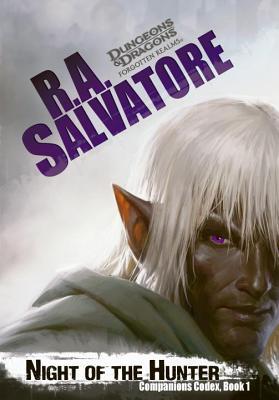
Book Review: Night of the Hunter by R.A. Salvatore
Night of the Hunter continues the Drizzt's story as he finally reunites with his companions and gains a new lease on life. Simultaneously, it tells the story of a major move by the ruling houses of the drow--and, by extension, Lolth--to consolidate their power in Menzobarranzan, and ultimately bring conflict to the surface world. And while that's happening, we also have the story of Artemis Entreri and his companions as they piece together what to do with themselves now that Drizzt has left them. As one can see, there's a lot going on here, and it's only as the novel reaches its conclusion that the disparate threads coalesce into single narrative.
The best part of this book is unquestionably the interesting look into drow culture. It tells the story of how the ruling matron mother, apparently guided by Lolth herself, is able to thwart the many schemes of her rivals while simultaneously bringing them under her command. While I'm not a big fan of drow, I really enjoyed this component of the book. I've often wondered how a group of such conniving, backstabbing people could still somehow achieve a structured society. This book provided a great look into a way that it could work, at least with the help of their horrible goddess.
Having survived a close brush with death, and finally in the company of those he loves most dearly, Drizzt seemed surprisingly passive in this book. He does his share of swordsmanship, of course, but largely seems to take a back seat to the immediate needs and desires of his friends. And it makes sense: he's so overjoyed to see them that I can imagine him wanting little more than to spend time with them. The result is some thrilling battle sequences as they venture into Gauntlgrym, along with some delightfully cheery character interactions scattered throughout the book.
There was one place where I found myself disappointed, however. I've seen Bob Salvatore talk about how the Sundering is an opportunity to return to the classic, simple, black-and-white of the past. He seems more comfortable in that framework, but to me it is the gray that has made his more recent books so interesting. I was particularly saddened to see his star characters dismiss the notion that a certain race of humanoids might not be, at their core, destined for evil. Drizzt himself struggles with this notion throughout the book, but I'm hopeful that future books will show at least some exceptions to this rule. Worlds are more interesting when there are shades of gray, rather than the strict black and white of humans vs. monsters.
That all said, it was a fun book to read. It's not my favorite of R.A. Salvatore's books, but it sets up a pretty interesting scenario for his future books to explore. I'm looking forward to the next one.
The best part of this book is unquestionably the interesting look into drow culture. It tells the story of how the ruling matron mother, apparently guided by Lolth herself, is able to thwart the many schemes of her rivals while simultaneously bringing them under her command. While I'm not a big fan of drow, I really enjoyed this component of the book. I've often wondered how a group of such conniving, backstabbing people could still somehow achieve a structured society. This book provided a great look into a way that it could work, at least with the help of their horrible goddess.
Having survived a close brush with death, and finally in the company of those he loves most dearly, Drizzt seemed surprisingly passive in this book. He does his share of swordsmanship, of course, but largely seems to take a back seat to the immediate needs and desires of his friends. And it makes sense: he's so overjoyed to see them that I can imagine him wanting little more than to spend time with them. The result is some thrilling battle sequences as they venture into Gauntlgrym, along with some delightfully cheery character interactions scattered throughout the book.
There was one place where I found myself disappointed, however. I've seen Bob Salvatore talk about how the Sundering is an opportunity to return to the classic, simple, black-and-white of the past. He seems more comfortable in that framework, but to me it is the gray that has made his more recent books so interesting. I was particularly saddened to see his star characters dismiss the notion that a certain race of humanoids might not be, at their core, destined for evil. Drizzt himself struggles with this notion throughout the book, but I'm hopeful that future books will show at least some exceptions to this rule. Worlds are more interesting when there are shades of gray, rather than the strict black and white of humans vs. monsters.
That all said, it was a fun book to read. It's not my favorite of R.A. Salvatore's books, but it sets up a pretty interesting scenario for his future books to explore. I'm looking forward to the next one.
Monday, March 17, 2014
The Reaver by Richard Lee Byers
The Reaver manages to combine almost non-stop action with interesting character development. The story revolves around the journey of Stedd, young boy who is the chosen of reincarnated Lathander who made a minor appearance in Erin Evans' book, The Adversary. Stedd is on a mission to Sapra, but is opposed by Evendur Highcastle, a grotesque, undead pirate raised by Umberlee as her Chosen. As the book begins, Highcastle has put out a bounty on Stedd, which all manner of scum seek to receive...including the main character of the book, a dastardly pirate named Anton Marivaldi. What follows is an interesting character journey in which Anton almost accidentally finds himself wrapped up in conflict surrounding the boy, Stedd, and ultimately undergoes a gradual, believable transformation.The characters are really central to this story. Anton is a fascinating character, a man who committed himself to impulse and greed who is suddenly faced with what to do with a boy of virtually pure goodness. There is also Umara, a brilliant Red Wizard of Thay, and cunning illusionist, and servant to a powerful vampire lord, Kymas. And finally, there is Evendur Highcastle, a bloated, rotting corpse reanimated to channel the power and machinations of Umberlee. It's a great cast, and I'm hopeful that we might someday see a sequel or spinoff to see what happens to some of the survivors.
This book is the 4th in the Sundering series. One can argue that it is the most "Sundering-y" of the bunch thus far. Whereas others hint at the machinations of the gods above, and we see Chosen struggling against one another to further their own goals and those of their dieties, The Reaver features battles among chosen on a grand scale. The entire book is set during the time of "The Great Rain," a period of endless rain that pounds the Sea of Fallen Stars and the nations that border it. The rain permeates everything in the novel, and its origin and meaning--natural, or divine--is one of its great mysteries. Furthermore, more overt divine magic permeates the book, and we are treated to epic sea battles as the forces of Umberlee clash with those of Lathander, Silvanus, and the wizards of Thay. And on top of all of that, there's everything one could hope for in a tale of buccaneers: infiltration, swashbuckling, sabotage, and ship-to-ship combat, all with a sprinkling of fantasy magic.
I had some minor criticisms. The last third of the book seemed, at times, a bit less polished than the first two thirds. But the book features so many points of high drama and excitement that I have no hesitation in giving it a strong review. It's a great read, and one of my favorite Forgotten Realms novels.
Saturday, February 8, 2014
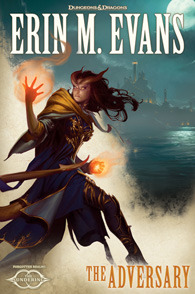
The Adversary by Erin Evans
I heard the author of The Adversary, Erin Evans, describe the premise of her book as this: Farideh, the central character, makes a very bad decision early on in the book. She then spends the rest of the book dealing with the consequences of that decision.
It's a terrific, spoiler-free encapsulation of the story. What I didn't realize heading into this is that the consequences arrive on many fronts. Immediately, her decision has dramatic consequences on the people she holds most dear: her inner circle of family and friends. But the consequences of her choice extend much further. They interface with vast plots that entangle her personal story with events that threaten to affect the balance of power not only in the mortal realm, but the realm of the Gods as well.
I really enjoyed this novel. The core characters of the book were all distinct and multidimensional, and most undergo substantial character development. There is a lot of gray here: there are flawed heroes, and there are characters who would be villains in most stories, but here are forced to become allies of good. The plot had good pacing, always seems to move at a fast clip. Finally...there was a great deal of subtlety in the novel. While it was not blatantly (or manipulatively) deceptive, we often were presented with incomplete information. Only later did we learn complete story. More so than any of the other Sundering novels to this point, I think this is one that I'd gain the most by reading a second time.
One thing I really like about the author's style is how different her narrative feels depending on the point of view from which she is writing in a given chapter. Sometimes, for example, we're treated to an interaction between Farideh and Lorcan, her devil patron, presented from Farideh's point of view. Later, however, we get treated Lorcan's perspective as he thinks back to that event. Needless to say, their interpretations of the events are often radically different.
I don't have much to criticize. Like Godborn, I noticed a few small editing mistakes here and there. One time, for example, I think "Brin"'s name showed up as "Erin," which was amusing. But really, reading this was such a pleasure. I'm really looking forward to Erin Evan's next novel.
Edit: Turns out the Brin for Erin thing was the result of "kerning." I am henceforth opposed to Kerns of any kind!
It's a terrific, spoiler-free encapsulation of the story. What I didn't realize heading into this is that the consequences arrive on many fronts. Immediately, her decision has dramatic consequences on the people she holds most dear: her inner circle of family and friends. But the consequences of her choice extend much further. They interface with vast plots that entangle her personal story with events that threaten to affect the balance of power not only in the mortal realm, but the realm of the Gods as well.
I really enjoyed this novel. The core characters of the book were all distinct and multidimensional, and most undergo substantial character development. There is a lot of gray here: there are flawed heroes, and there are characters who would be villains in most stories, but here are forced to become allies of good. The plot had good pacing, always seems to move at a fast clip. Finally...there was a great deal of subtlety in the novel. While it was not blatantly (or manipulatively) deceptive, we often were presented with incomplete information. Only later did we learn complete story. More so than any of the other Sundering novels to this point, I think this is one that I'd gain the most by reading a second time.
One thing I really like about the author's style is how different her narrative feels depending on the point of view from which she is writing in a given chapter. Sometimes, for example, we're treated to an interaction between Farideh and Lorcan, her devil patron, presented from Farideh's point of view. Later, however, we get treated Lorcan's perspective as he thinks back to that event. Needless to say, their interpretations of the events are often radically different.
I don't have much to criticize. Like Godborn, I noticed a few small editing mistakes here and there. One time, for example, I think "Brin"'s name showed up as "Erin," which was amusing. But really, reading this was such a pleasure. I'm really looking forward to Erin Evan's next novel.
Edit: Turns out the Brin for Erin thing was the result of "kerning." I am henceforth opposed to Kerns of any kind!
@Berliad I peeked. Brin/Erin error is kerning issue w/ the italics in the ebook! The text is correct, it just chops off the front of the B.
— Erin M. Evans (@erinmevans) February 9, 2014
Monday, December 2, 2013
The Godborn by Paul Kemp
In many ways, The Godborn was vastly superior to R.A. Salvadore's The Companions, the book that preceded it in the Sundering series. It is only loosely connected, which was as expected. What was unexpected was how easy it was to step into Paul Kemp's world. I hadn't read any of the previous Everis Cale books. Aside from spending some time reading Kemp's excerpts, and then looking up some of the names and characters on the Forgotten Realms Wiki, I had no experience with any of the preceding content. Nevertheless, I found this book very approachable and easy to dive into. In fact, I read the vast majority of it in a four-day span over Thanksgiving.
The summary: it's very good. It has excellent pacing. Despite the fact that much of the first two thirds of the book is largely preparatory, the whirl-wind, stunning last third of the book manages to wrap up most of the innumerable apparently disjointed threads introduced early on without seeming rushed or anti-climactic. Kemp writes excellent dialog and presents some wonderfully believable characters. In contrast with the chaotic but wonderfully energetic battle scenes that Salvadore composes, Kemp's combat scenes are far more cinematic and visually descriptive. It begins as a very gritty, down-to-earth book, but as it moves along the action rises to grander and grander scales. It was hard to put down, and never felt slow.
In the end, we have a very satisfying conclusion to a saga that I only know in part. As excited I was to see it end, I can only imagine what someone who has read all of the Cale books must feel at its end. It was riveting from start to finish.
I do have a few critiques. First, the book does have substantial horror elements that are critical to the plot. I'm not a big fan of horror, but I get it and it works for the novel. There was one set of characters, however, that seemed to be created strictly to pound one the reader's emotional heartstrings. This is unfortunately very obvious from the start, and to me felt far too transparent. Furthermore, while it sets up a tale of revenge, this is never really allowed to run its course in a satisfying way.
Second, I was surprised to see a number of editing problems in the kindle version that I read. There were several cases where words or sentences were spliced together incorrectly. Furthermore, there were some plot inconsistencies. At one point, Vasen loses an important item to the Shadovar. Then, later, the book mentions him using it again, only to later remind us that the Shadovar have it. I wasn't the only one who noticed either--my Kindle noted that three people had underlined both of those passages.
Still, it was a great book. If the first two thirds were a 3-4 star, the brilliant conclusion easily justifies a 5-star rating. I'm not sure if we'll see more of Everis or Vasen Cale, or their surviving companions. But if so, I will gladly and eagerly read on.
Saturday, November 30, 2013
The Companions by R.A. Salvadore
Some minor spoilers below, mostly from the first few chapters of the book.
The Companions was quite a surprise. I left R.A. Salvadore's story after finishing the Paths of Darkness's final book, the Sea of Swords. Wulfgar, now with an adopted child, had finally come to grips with his traumatic past and had taken steps to stride into his future. He'd been reunited with the the Companions and found his great warhammer, while Drizzt and Cattie-brie had fallen in love. I missed what happened next: the deaths of the Companions, and Drizzt's adventures with his new associates--those who did not share his morals and ideals.
Now, as The Companions begins, Bruenor, Cattie-Brie, Regis, and Wulfgar find themselves in a kind of strange pocket-plane created by Mielikki, a goddess of nature and the patron of Drizzt. They are faced with a choice: do they continue on to their just reward, or do they instead accept a gift from Mielikki and be reincarnated on Toril, tasked to help Drizzt in his time of need. What follows is the story of how those who choose to return are born and live through their early years once again. It explores an interesting question: what would it be like to live your life again, having the memories, knowledge, and cognitive function of your prior life?
Each of the characters' new life story is faced with its own challenges, and in these we see each character grow and develop in leaps and bounds. Their stories dominate this book--in truth, Drizzt gets far less screen time than the cover might suggest--and each has an eventful childhood and early adolescence. By the end of the story, several are quite simply not who they were when the tale began. Some of the individual plot-lines work better than others, but overall it is an enjoyable read...and a book that has me eagerly awaiting the next in the series.
A few specific comments (major spoilers follow!!)
The Companions was quite a surprise. I left R.A. Salvadore's story after finishing the Paths of Darkness's final book, the Sea of Swords. Wulfgar, now with an adopted child, had finally come to grips with his traumatic past and had taken steps to stride into his future. He'd been reunited with the the Companions and found his great warhammer, while Drizzt and Cattie-brie had fallen in love. I missed what happened next: the deaths of the Companions, and Drizzt's adventures with his new associates--those who did not share his morals and ideals.
Now, as The Companions begins, Bruenor, Cattie-Brie, Regis, and Wulfgar find themselves in a kind of strange pocket-plane created by Mielikki, a goddess of nature and the patron of Drizzt. They are faced with a choice: do they continue on to their just reward, or do they instead accept a gift from Mielikki and be reincarnated on Toril, tasked to help Drizzt in his time of need. What follows is the story of how those who choose to return are born and live through their early years once again. It explores an interesting question: what would it be like to live your life again, having the memories, knowledge, and cognitive function of your prior life?
Each of the characters' new life story is faced with its own challenges, and in these we see each character grow and develop in leaps and bounds. Their stories dominate this book--in truth, Drizzt gets far less screen time than the cover might suggest--and each has an eventful childhood and early adolescence. By the end of the story, several are quite simply not who they were when the tale began. Some of the individual plot-lines work better than others, but overall it is an enjoyable read...and a book that has me eagerly awaiting the next in the series.
A few specific comments (major spoilers follow!!)
Wednesday, August 7, 2013
More Sundering Movies
For some reason, I didn't see this at the DnD website, but the DnD Youtube Channel has two new videos about the Sundering books. Not much new, but they're worth the quick watch.
(fwiw, I wonder about when the conference footage was filmed. It pretty much has to be recent, because it has the most recent artwork for each of the characters plastered on the walls!)
Now, if you'll excuse me, I'm off to go read The Companions. ;)
(fwiw, I wonder about when the conference footage was filmed. It pretty much has to be recent, because it has the most recent artwork for each of the characters plastered on the walls!)
Now, if you'll excuse me, I'm off to go read The Companions. ;)
Tuesday, August 6, 2013
The Sundering is Upon Us
So says the video at Wizards of the coast!
This coincides with the release of R.A. Salvadore's new novel, The Companions, which is the first of the six Sundering novels. I'm planning to read these as they are released, and I really look forward to them.
There is also a new facebook "game," which amounts to a character tracker for dnd encounters players working through the Murder in Baldur's Gate adventure. I'll be DMing that adventure, though given that it will be done via play by post, I expect that we'll reach milestones long after the Encounters people do. Still, I'm signed in there. Why not?
I'm pretty excited about this event. Despite the video's rather scripted, we-know-everything-that-will-happen feel, this is going to my first real foray into the Forgotten Realms as a D.M. By all accounts, it seems as though they've done their best to execute this event with as much forethought and inclusion as possible. I like that the Sundering Six authors have been heavily involved in decisions, and that they're allowing the outcomes of the two Sundering adventures to shape the future of the realms in apparently meaningful ways.
The Realms are a world that I've experienced primarily in video games thus far, and I'm looking forward to getting to play in that world.
So, down with Bhaal! I'm looking forward to getting started.
This coincides with the release of R.A. Salvadore's new novel, The Companions, which is the first of the six Sundering novels. I'm planning to read these as they are released, and I really look forward to them.
There is also a new facebook "game," which amounts to a character tracker for dnd encounters players working through the Murder in Baldur's Gate adventure. I'll be DMing that adventure, though given that it will be done via play by post, I expect that we'll reach milestones long after the Encounters people do. Still, I'm signed in there. Why not?
I'm pretty excited about this event. Despite the video's rather scripted, we-know-everything-that-will-happen feel, this is going to my first real foray into the Forgotten Realms as a D.M. By all accounts, it seems as though they've done their best to execute this event with as much forethought and inclusion as possible. I like that the Sundering Six authors have been heavily involved in decisions, and that they're allowing the outcomes of the two Sundering adventures to shape the future of the realms in apparently meaningful ways.
The Realms are a world that I've experienced primarily in video games thus far, and I'm looking forward to getting to play in that world.
So, down with Bhaal! I'm looking forward to getting started.
Subscribe to:
Posts (Atom)