|
| Meet the Normandy, the pride of the Alliance fleet. |
In
Mass Effect, Bioware's space epic (released 2007), you play the role of Commander Shepherd, an elite Marine of the Earth's Alliance space force. Assigned to the Normandy, a prototype frigate in the Marine Navy, you are sent on a covert mission to recover a strange artifact recently discovered on the human colony, Eden Prime. On that mission, you face a threat that was thought to have retreated to the other side of the galaxy: the Geth, a race of sentient robots who overthrew their creators, the Quarians. While the Geth were known to exist on the other side of the Milky Way Galaxy, they hadn't invented space overseen by the allied races of the citadel in years. Disturbingly, their emergence this time seemed to revolve around the Prothean artifact, a relic of an advanced alien species that built an empire across the galaxy, and then mysteriously disappeared.
 |
| Explore dozens of systems in the Milky Way Galaxy |
That's the hook for what becomes a tremendous story that will have you jumping between dozens of star systems across the galaxy. It's a beautifully written and skillfully executed tale that gradually peels back at the layers of its mysteries, only to reveal a deeper and more nuanced one underneath. I found it very original and full of surprises, and yet nothing felt contrived. Furthermore, despite being the first of a trilogy, a lot happens in this game; by the end, you feel as though you've really accomplished something. You are forced to make hard decisions in this game, and your decisions really do matter. I was impressed at how much of the dialog and cutscenes must have been crafted for my character's choices; had I chosen otherwise, entirely different animations and spoken dialog would have been necessary. This didn't just happen one or two times; this happened repeatedly throughout the game.
 |
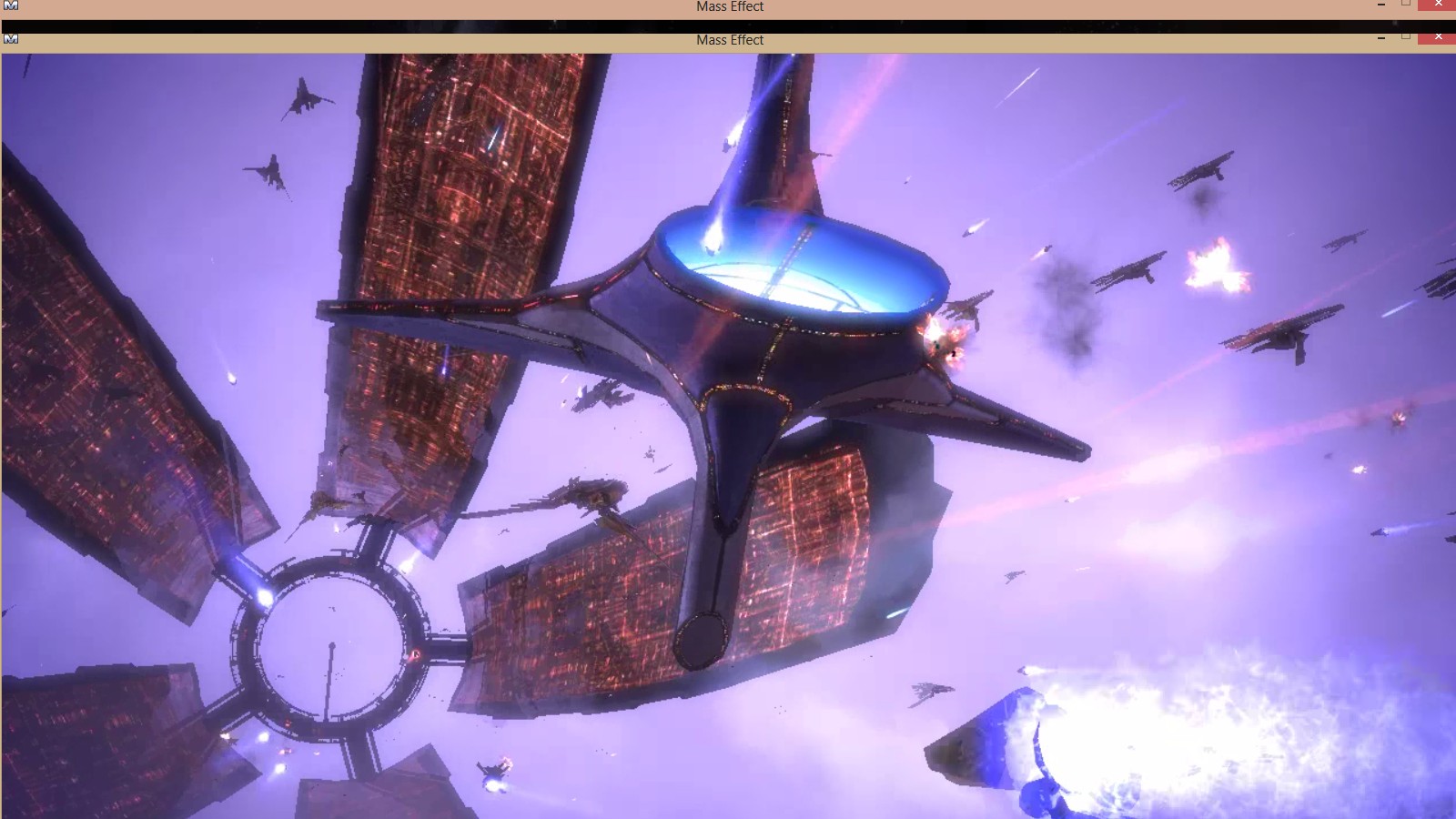
The Citadel, the center of the allied races' galactic
civilization, is an enormous space station of
mysterious origin. |
Accompanying you along your journey are a wonderful cast of characters. Some are bystander NPC's that never fight along side you, but are nevertheless so well written and developed--and voiced! The voice acting is SO GOOD!--that they nevertheless had a great impact on my experience while playing. The depth of some of the six NPC's that accompany you varies; some are fairly superficial and exist largely to introduce you to their particular race. Others are deeper, with their own backstory and motivations that inform their reactions during your missions. Several characters have missions that are clearly designed with them in mind, which encourages you to take them along and vary up your party composition.
This is the second "shooter RPG" I've played in recent years; the first was Fallout 3. Like Fallout, Mass Effect has features designed to help ease along those like me who aren't particularly twitch-oriented gamers. Most important is the ability to pause the game. By holding down the spacebar, you can collect your thoughts, select powers, and even aim your weapon at a foe before releasing the spacebar and pulling the trigger. It's a big help and takes away some of the steep skill requirements needed in other shooters, while still requiring that you move, dodge, strafe, and fire your weapon in real time. Furthermore, cover is really important in this game, especially early on. The secret to many fights is getting yourself behind cover, defending your position, and yet still knowing when to take the fight to the enemy (they'll be using cover too!).
 |
While this is not a space combat game, there are some
amazing cutscenes. |
I played through the game as a Vanguard, which is designed as a character who combines close combat with "biotics," which are the Mass Effect universe's version of magic. It's a great class; you specialize in shotguns and have access to biotics like Barrier, which creates a powerful shield around you to complement your armor's own inherent shields. On top of that, you have enough points to invest in a few other offensive biotics. I primarily invested in throw, which is a "jedi-style" power that permits you to toss would-be assailants away from you, knocking them down for a few seconds. Others, such as lift or singularity, were even more powerful, but I opted to stick to Throw along with my "martial" powers and barrier. I found the game challenging, but rarely frustrating. There were really only two fights that required more than a single reload for me to completely, and in one case I'd simply stumbled upon a sidequest designed for a higher-level character than my own.
 |
Ashley, a compassionate, yet hot-headed infantry soldier
is one of many outstanding NPC's with which you
experience the game. |
The most maligned aspect of the game, at least upon its release, was the use of the Mako tank during outdoor missions. Subsequent patches must of done a world of good to improve the Make controls, because I found this part of the game exhilarating. On super-rough terrain, as exists on many of the planets you'll explore, the Mako does get tossed around quite a bit, making one wonder what kinds of inertia-damping the harnesses inside the tank must have allow someone to survive. But the worlds you explore are breathtaking. Each has its own unique description, and that description is manifested in how the world is rendered. Personal favorite worlds included planets that orbited binary stars, moons around gas giants that take up most of the sky, and even a "binary" world--a pair of similarly-sized planets that spiral around one another as they orbit a star. Most worlds, as one would expect, are desolate. But a small few harbor their own, native, multicellular life, and much of the background writing about the worlds focuses on past or current attempts to colonize, terraform, or mine these distant worlds.
 |
| Scenes like this never get old. |
I bought Mass Effect in 2008, not too long after its release via direct2drive (my first digital game purchase!). For reasons that I don't remember, I stopped about a quarter of the way through the game. I remember that it was getting hard; I hadn't chosen a great class, and I remember struggling with the shooter aspects of the game far more than I did this time. My 100+ hours of Fallout 3 were great training, even though I played Fallout 3 on my Xbox and Mass Effect on my PC. This time around, I finished the game in about a month, despite the fact that I simultaneously went through my end of semester crunch. It's not an incredibly long game, maybe 40-50 hours or so. But it has plenty of depth and plot to make for an extremely satisfying experience. I'm itching to dive straight into Mass Effect 2, but I don't want to risk burnout. Therefore, I'm going to play a couple of other titles I already own in the meantime (namely, X-Com, Witcher II). Nevertheless, I'm already itching to return to this universe; I'm sure that it will not be long.